

UniFi UCG Industrial Review: When the Ruggedized Chassis Justifies the Price
Full UCG Industrial review with verified specs, real-world deployment, and comparison to the UCG Fiber. $579 buys a fanless, ruggedized WiFi 7 gateway with 270W PoE — here's when it makes sense.


The Cloud Gateway Industrial is the first product in Ubiquiti's new UniFi Industrial series — a ruggedized, fanless WiFi 7 gateway designed for environments where a standard cloud gateway would overheat, collect dust, or struggle to operate reliably. At $579, it packs a 10 GbE port, 270W of PoE output across five ports, built-in dual-band WiFi 7, and the full UniFi application suite into a wall-mountable aluminum chassis rated from -30 to 50°C.
We deploy UniFi networks for businesses across South Florida, and we have a specific project where the UCG Industrial is the right tool. This review covers when the ruggedized chassis justifies the $300 premium over alternatives like the UCG Fiber — and when it does not.
Affiliate Disclosure: This article contains affiliate links. If you make a purchase through these links, we may earn a small commission at no extra cost to you. As an Amazon Associate, iFeelTech earns from qualifying purchases.
Bottom Line
The UCG Industrial earns its price in a narrow but real set of scenarios: warehouse receiving areas, retail back-of-house, manufacturing floors, and outdoor-adjacent deployments where there is no IT closet, no rack, and no climate control. The 270W PoE budget and built-in WiFi 7 mean you can wall-mount a single device and have a complete network. For standard offices with even a basic network closet, a standard UniFi gateway like the UCG Fiber ($279) or UCG Max ($199) gives you the same 5 Gbps IDS/IPS with better storage options and a lower entry price.
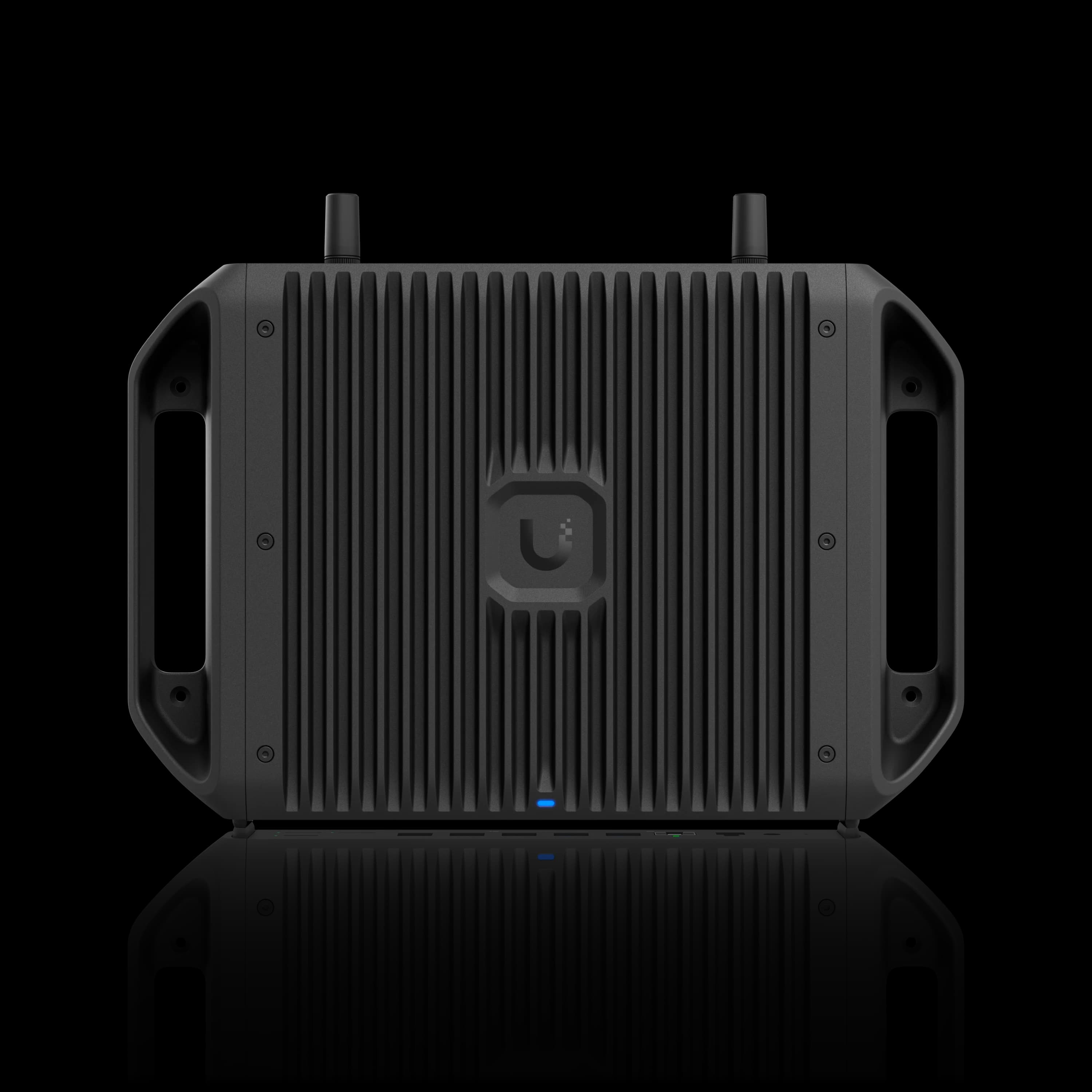
Cloud Gateway Industrial
Ruggedized, fanless 10 GbE gateway with built-in WiFi 7, 270W PoE, and full UniFi application support.
- Fanless, -30 to 50°C rated
- 270W PoE (3x PoE+++ at 90W)
- Built-in WiFi 7 (dual-band)
- 5 Gbps IDS/IPS throughput
*Price at time of publishing
Pros
- Fully fanless, ruggedized aluminum chassis rated -30 to 50°C with ESD/EMP protection
- 270W PoE budget across five ports (three 802.3bt at 90W each) eliminates a separate PoE switch
- Built-in dual-band WiFi 7 (802.11be / BE5000) with external antennas and MLO support
- 5 Gbps IDS/IPS throughput — identical to the UCG Fiber and rack-mount gateways
- Wall-mount, desktop, or rack-mount ($69 accessory) deployment flexibility
- Site Magic SD-WAN and dual Nano SIM slots for multi-site and cellular failover readiness
Cons
- $579 is a $300 premium over the UCG Fiber with the same processor and throughput
- microSD-only storage (128 GB) limits UniFi Protect to roughly 3-5 days of recording with two cameras
- Dual-band WiFi only — no 6 GHz band, and 2x2 streams limit large-area coverage
- Only 1x 10G SFP+ port versus the UCG Fiber's 2x SFP+
- 350W power brick is physically bulky for wall-mount deployments
- No official IP rating (IP66/IP67) — ruggedized means thermal and ESD resilience, not water sealing
Our Take: Great Product, Narrower Use Case Than You'd Expect
We work with a lot of businesses in South Florida, and we have installed several warehouse networks across the region. Most warehouses have an office section with an IT room or at minimum an IT closet. In those scenarios, a rack-mounted setup with a gateway like the UCG Fiber or UDM Pro Max, a PoE switch, and dedicated APs is still the better option — more storage, more 10G ports, and a cleaner separation of concerns.
That said, we have a current project where the UCG Industrial is a strong fit.
The setup: a client's receiving warehouse in a separate building block from their main facility. Open layout, no office area, no IT closet. They already have a Comcast cable connection in the space. The UCG Industrial will be the single router and wireless device in the warehouse — wall-mounted at a central location near the receiving area, serving two workstations and a printer. We will use Site Magic to connect this satellite warehouse back to the main site's network.
There is no rack, no cable runs to a closet, and no separate switch — one device on the wall handles routing, WiFi, and PoE.
That is the sweet spot for the UCG Industrial. But we want to be transparent: if this warehouse had a small office with a closet, we would have deployed a UCG Fiber and a PoE switch instead.
This installation is scheduled for April 2026 — we will update this review with photos and performance data once the deployment is complete.
UCG Industrial Hardware Specifications
The UCG Industrial runs the same quad-core ARM Cortex-A73 processor at 2.2 GHz and 3 GB of RAM as the UCG Fiber. The IDS/IPS throughput is identical at 5 Gbps. What is different is everything surrounding that silicon.
Ports and Connectivity
| Port | Speed | PoE | Default Role |
|---|---|---|---|
| 1x 10G SFP+ | 10G/1G | — | WAN |
| 1x 10GbE RJ45 | 10G/5G/2.5G/1G | PoE+++ (90W) | WAN |
| 2x 2.5 GbE RJ45 | 2.5G/1G | PoE+++ (90W) | 1x WAN / 1x LAN |
| 2x 2.5 GbE RJ45 | 2.5G/1G | PoE+ (30W) | LAN |
Any port can be reassigned between WAN and LAN roles. The maximum WAN port count is five — useful for multi-WAN failover or load balancing across fiber, cable, and cellular connections simultaneously.
Full Specifications
| Specification | UCG Industrial |
|---|---|
| Price | $579 |
| Processor | Quad-core ARM Cortex-A73 at 2.2 GHz |
| RAM | 3 GB |
| Storage | 128 GB microSD (pre-installed) |
| IDS/IPS Throughput | 5 Gbps |
| PoE Budget | 270W (DC input) / 75W (ATX power) |
| Max PoE per Port | 90W (PoE+++) / 30W (PoE+) |
| WiFi | Dual-band WiFi 7 (2x2), BE5000 |
| WiFi Coverage | 115 m² / 1,250 ft² (official) |
| Operating Temp | -30 to 50°C (-22 to 122°F) |
| Humidity | 5–95% noncondensing |
| ESD/EMP Protection | Air ±8kV, contact ±4kV |
| Fanless | Yes |
| NDAA Compliant | Yes |
| Dimensions | 307.9 x 203.5 x 43.7 mm (12.1 x 8 x 1.7") |
| Weight | 2.4 kg (5.3 lb) |
| Power Supply | 350W PSU (54V DC), adapter included |
| Device Power Consumption | 28W (excluding PoE output) |
| SIM Slots | 2x Nano SIM (Remote SIM with UniFi 5G Max Outdoor) |
| Max Managed Devices | 50+ |
| Max Clients | 500+ |
| Max Cameras | 15 HD / 8 2K / 5 4K |
| UniFi Applications | Network, Protect, Access, Talk, Connect |
| Form Factor | Wall-mount, desktop (stand included), rack ($69 accessory) |
| Antennas | External removable (stub: 3–5 dBi, terminal omni: 6 dBi) |
| Certifications | CE, FCC, IC |
UniFi Application Suite
The UCG Industrial runs the full suite locally:
- UniFi Network: Routing, firewall, VLANs, VPN, traffic management
- UniFi Protect: Video surveillance with the pre-installed 128 GB microSD
- UniFi Talk: VoIP communications
- UniFi Access: Door access control
- UniFi Connect: Digital signage and EV station management
The 128 GB microSD storage is the practical ceiling for Protect — approximately 3-5 days of motion-triggered 1080p recording with two cameras. For anything beyond a handful of cameras, you will need a separate UNVR or a gateway with NVMe storage such as the UCG Fiber or UDM Pro Max.
Introducing: UniFi Industrial — Official Ubiquiti Overview
What Is the Difference Between the UCG Industrial and UCG Fiber?
The UCG-Industrial adds a ruggedized fanless chassis, built-in WiFi 7, and 270W of PoE output for a $300 premium over the UCG-Fiber. Both share the same quad-core ARM Cortex-A73 processor, 3 GB of RAM, and 5 Gbps IDS/IPS throughput. The price difference is $579 vs $279 for the base UCG Fiber — here is what that premium includes and what you trade away.
| Specs | ||
|---|---|---|
| IDS/IPS Throughput | 5 Gbps | 5 Gbps |
| WiFi | Dual-band WiFi 7 (2x2) | None |
| PoE Budget | 270W (3x PoE+++ / 2x PoE+) | 30W (1x PoE+) |
| 10G Ports | 1x SFP+ + 1x RJ45 | 2x SFP+ + 1x RJ45 |
| Storage | 128 GB microSD only | NVMe SSD (up to 2TB) |
| Operating Temp | -30 to 50°C | 0 to 40°C |
| Fanless | Yes | No (internal fan) |
| Form Factor | Wall-mount / desktop / rack | Desktop / rack |
| Power Supply | 350W adapter | 60W adapter |
| SIM Slots | 2x Nano SIM | None |
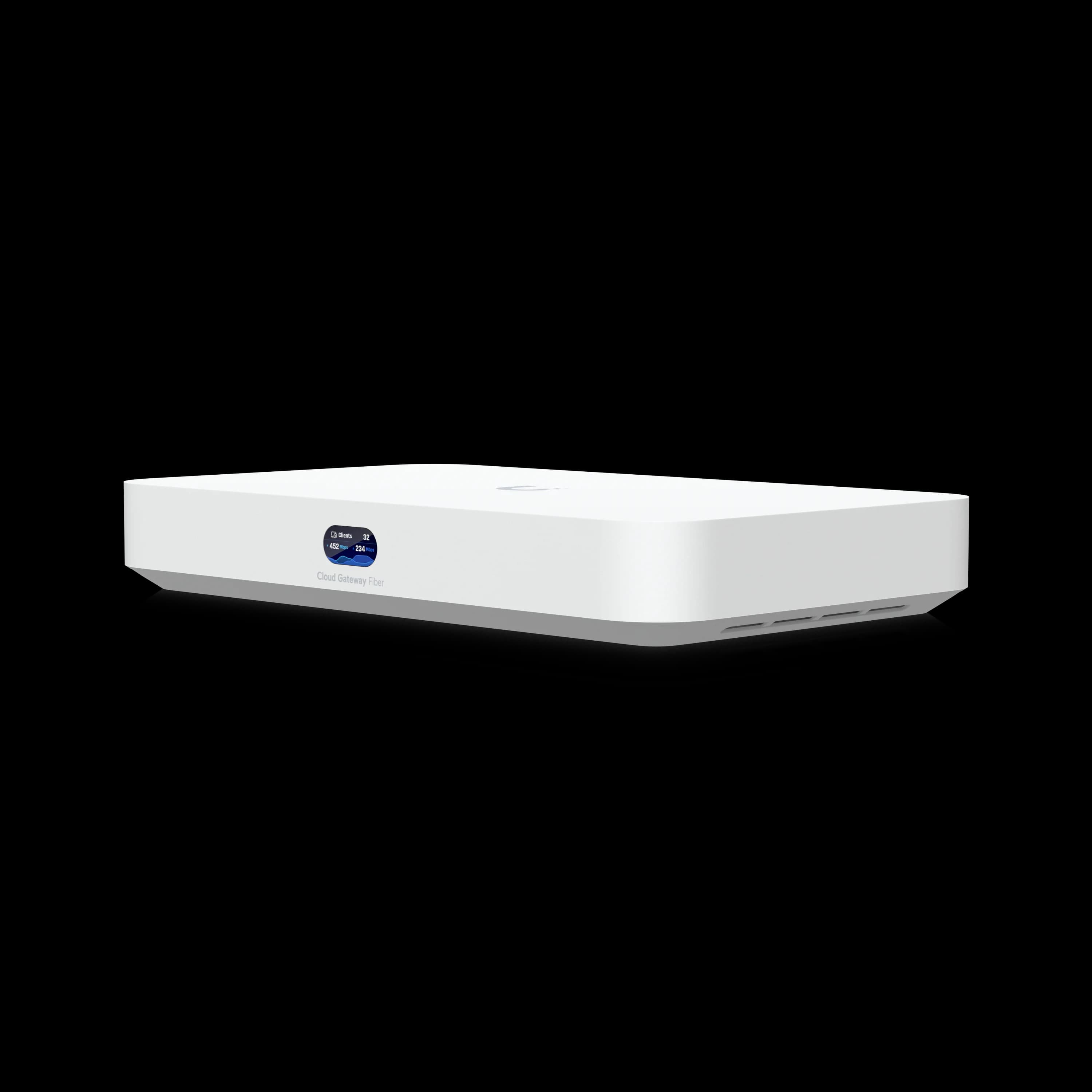
What the $300 Premium Gets You
- Ruggedized, fanless chassis. Rated -30 to 50°C versus the Fiber's 0 to 40°C. No moving parts to fail in dusty or vibration-heavy environments.
- Built-in WiFi 7 (802.11be). Dual-band 2x2 BE5000 with external antennas and MLO support. The UCG Fiber has no WiFi — you need a separate AP.
- 270W PoE across 5 ports. Three 802.3bt (PoE+++) ports deliver up to 90W each. The UCG Fiber has a single 802.3at (PoE+) port at 30W.
- Wall-mount form factor. Designed for environments without racks. The Fiber is a desktop unit (rack mount also available with accessory).
- 2x Nano SIM slots. For Remote SIM provisioning with the UniFi 5G Max Outdoor. The Fiber has no SIM slots.
- ESD/EMP protection. Air ±8kV, contact ±4kV. Built for electrically noisy environments near industrial equipment.
What You Give Up
- NVMe storage. The Fiber supports up to 2TB NVMe for Protect. The Industrial is limited to microSD (128 GB included). This is the single biggest trade-off.
- Second 10G SFP+ port. The Fiber has 2x SFP+ ports; the Industrial has 1x.
- Size and weight. The Industrial weighs 5.3 lb with a 350W power brick. The Fiber is 1.5 lb with a 60W adapter.
- Cost. $300 buys a lot of separate infrastructure — a PoE switch, an AP, and still have change left.
When to Choose Each Gateway
Choose the UCG Industrial if:
- There is no IT closet, server room, or rack space at the deployment site — warehouses, distribution centers, retail backrooms, construction trailers
- The environment involves temperature extremes, dust, or vibration — manufacturing floors, workshops, outdoor kiosks, covered deployments
- You need a single wall-mounted device that handles routing, WiFi, and PoE for a satellite location connected via Site Magic
- Cellular failover via SIM is on the roadmap
- Protect recording needs are minimal (a few cameras, motion-only on the 128 GB microSD)
Choose the UCG Fiber if:
- You have any kind of closet or rack space — a $279 gateway plus a PoE switch and separate AP is more flexible with better storage
- You need NVMe storage for UniFi Protect (more than a few cameras) — the Fiber supports up to 2 TB
- You need 2x 10G SFP+ ports for high-bandwidth uplinks or downlinks
- Budget matters — $279 gets you the same routing and security engine
- You already have or plan dedicated APs — the Industrial's built-in WiFi becomes redundant at $300 extra
Does the UCG Industrial Have Built-in WiFi?
The UCG-Industrial features an integrated dual-band WiFi 7 (802.11be / BE5000) access point with external antennas covering approximately 1,250 square feet. The 2x2 radio operates on the 2.4 GHz and 5 GHz bands with Multi-Link Operation (MLO) support. No 6 GHz band. Combined theoretical throughput is approximately 5 Gbps.
That is modest next to the UDR7's tri-band BE11000 or a standalone U7 Pro. But context matters: the UCG Industrial is providing WiFi in a warehouse receiving area, a retail stockroom, or a construction trailer — not competing for streaming benchmarks.
For those environments, dual-band 2x2 WiFi 7 is sufficient. Expect consistent gigabit-plus speeds at reasonable distances over the 5 GHz band or MLO SSID. The included 6 dBi omnidirectional terminal antennas provide superior range compared to the internal antennas in compact consumer hardware.
If the built-in WiFi falls short — say the warehouse is 5,000+ sq ft — the 270W PoE budget lets you add a U7 Pro or U7 Outdoor AP directly from the gateway. No separate switch needed. The UCG Industrial manages it as part of the same UniFi network automatically.
What Devices Can the UCG Industrial PoE Ports Power?
The UCG-Industrial's 270W PoE budget powers high-draw edge devices including access points, PTZ cameras, and storage arrays via three 802.3bt (PoE+++) ports rated at 90W each. The remaining two ports support 802.3at (PoE+) at 30W.
A single 802.3bt port can power a UniFi LEO satellite terminal, a UNAS 4 PoE storage server, or any standard PoE camera and AP. In a small deployment, this eliminates an entire PoE switch from the bill of materials.
What 270W PoE (802.3bt / 802.3at) Can Power Directly
| Device | Power Draw | Port Required |
|---|---|---|
| UniFi U7 Pro AP | ~13W | PoE+ |
| UniFi G6 Bullet Camera | ~12W | PoE+ |
| UniFi UNAS 4 | ~60W | PoE+++ |
| UniFi Access Hub | ~12W | PoE+ |
| UniFi 5G Max Outdoor | ~30W | PoE+ |
A realistic warehouse deployment — one AP, two cameras, and an access hub — draws roughly 50W total. The 270W budget leaves significant headroom for expansion.
What's Missing
The UCG Industrial has a few gaps that matter depending on your use case.
microSD-Only Storage
This is the biggest limitation. The UCG Fiber offers NVMe storage up to 2TB for UniFi Protect. The UCG Industrial uses a microSD card slot with 128 GB pre-installed. For Protect recording, 128 GB provides approximately 3-5 days of motion-triggered 1080p recording with two cameras, depending on activity levels. Anything beyond light surveillance demands a separate UNVR (~$199 for the UNVR Instant) or a gateway with NVMe storage.
No 6 GHz WiFi Band
The built-in WiFi is dual-band only — 2.4 GHz and 5 GHz. No 6 GHz support means no access to the cleanest, least congested spectrum. For a warehouse with minimal RF interference this is rarely an issue, but in denser RF environments (retail strip malls, shared buildings) the 6 GHz band would help.
Only One 10G SFP+ Port
The UCG Fiber has two SFP+ ports — one for WAN, one for a 10G LAN downlink. The Industrial has one SFP+, so if your WAN is fiber SFP+, your LAN downlink maxes out at the 10 GbE RJ45 port. In practice, most Industrial deployments use cable or cellular WAN where this is irrelevant, but it limits fiber-to-fiber pass-through scenarios.
The 350W Power Brick
The included 54V DC power supply is physically large — nearly half the size of the gateway itself. For a wall-mount deployment, plan for a nearby outlet and a way to secure the adapter. The alternative is ATX power (48V) if you are integrating into a custom enclosure, but the PoE budget drops to 75W on ATX.
No Built-in Cellular Modem
The two Nano SIM slots look like they should enable cellular failover directly. They do not. The SIMs use Remote SIM provisioning with the separate UniFi 5G Max Outdoor ($399), which is a PoE-powered outdoor modem you mount on a pole or wall. The SIM slots let you manage cellular plans without climbing up to the modem. Useful, but not the same as a built-in modem like the Dream Router 5G Max offers.
No Official IP Rating
The UCG Industrial carries no IP rating such as IP66 or IP67. The term "ruggedized" refers specifically to thermal resilience (-30 to 50°C fanless operation) and ESD/EMP protection (air ±8kV, contact ±4kV) — not sealed enclosures for water or heavy industrial dust ingress. There are no port covers or drip overhangs on the chassis. The device is suitable for dry indoor environments or covered outdoor deployments, but it should not be exposed to direct rain, pressure washing, or persistent airborne particulate.
No Shadow Mode (Gateway Failover)
Shadow Mode high availability (VRRP) is reserved for rack-mount gateways: UDM Pro Max, UDM Pro, UDM SE, EFG, and UXG Enterprise. The UCG Industrial does not support active-passive gateway failover. For deployments requiring zero-downtime redundancy, a rack-mount gateway with Shadow Mode is the appropriate choice.
Our Deployment: Satellite Warehouse in South Florida
Here is a current project where we are deploying the UCG Industrial, and why it won over other options.
The Scenario
Our client operates a main warehouse with a full UniFi rack deployment — UDM Pro Max, managed PoE switches, multiple APs, and a UNVR for camera recording. A separate building block on the same property serves as a receiving warehouse. This receiving area has:
- Open floor plan, no office space, no IT closet
- An existing Comcast cable internet connection
- Two workstations at the receiving desk
- One network printer
- A need to access shared resources on the main warehouse network
Why the UCG Industrial Won
| Option Considered | Why We Ruled It Out |
|---|---|
| UCG Fiber + PoE switch + AP | No closet to house the equipment. Would need a wall-mounted rack, additional power, more cable runs. Overkill for 2 workstations. |
| UDR7 | Only 1x PoE port (15.4W), no PoE+++ for future expansion. Indoor consumer form factor. |
| UCG Max + AP + injector | No 10G ports, no built-in WiFi, adds complexity with injectors. |
| UCG Industrial | Wall-mount at center receiving area. Built-in WiFi covers the open layout. PoE ports available for a future camera. Site Magic connects to the main warehouse. One device, done. |
The Network Design
The UCG Industrial will be wall-mounted at a central pillar in the receiving area. The two workstations connect via Ethernet runs from the gateway's LAN ports. The printer connects to one of the remaining LAN ports. The built-in WiFi serves handheld scanners and mobile devices on the warehouse floor.
Site Magic creates a secure site-to-site VPN tunnel back to the main warehouse's UDM Pro Max, giving the receiving area full access to the shared file server, ERP system, and print queue on the main network. No manual VPN configuration — Site Magic handles it through the UniFi Site Manager portal.
The Cost Math
| UCG Industrial Deployment | UCG Fiber + Rack Deployment |
|---|---|
| UCG Industrial: $579 | UCG Fiber: $279 |
| Wall-mount hardware: included | Small wall-mount rack: ~$80 |
| PoE switch (USW-Lite-8-PoE): $109 | |
| U7 Lite AP: $99 | |
| Additional cable runs: ~$150 | |
| Total: $579 | Total: ~$717 |
The Industrial deployment is actually cheaper when you factor in the rack, switch, AP, and cabling. More importantly, it is considerably simpler — one device, one power cable, one wall mount.
If you need Protect recording beyond the 128 GB microSD, add a UNVR Instant (~$199) to the Industrial column, bringing the total to ~$778. At that point the UCG Fiber stack's ~$717 with NVMe storage becomes the more cost-effective architecture for surveillance-heavy deployments.
Routing and Security Performance
The UCG Industrial delivers 5 Gbps routing throughput with IDS/IPS enabled — identical to the UCG Fiber and more than double the UCG Max's 2.3 Gbps. For the vast majority of business internet connections (including multi-gig fiber), the routing engine is not the bottleneck.
Security Features
- Stateful firewall with zone-based rules (UniFi Network 9.0+)
- Application-aware Layer 7 firewall for traffic identification and blocking
- IDS/IPS with 55,000+ signatures (CyberSecure subscription, $99/year)
- Content filtering and ad blocking
- DPI and traffic identification for visibility into bandwidth usage
- VLAN segmentation for isolating guest, IoT, and production networks
VPN and SD-WAN
- Site Magic: Zero-configuration site-to-site VPN via Ubiquiti's SD-WAN infrastructure. Hub & spoke or distributed topologies. No licensing fees.
- WireGuard, OpenVPN, IPsec server and client support
- Teleport: One-click remote access VPN for mobile devices
- L2TP for legacy client compatibility
For our warehouse deployment, Site Magic is the critical feature. It establishes a persistent, encrypted tunnel between the receiving warehouse and the main facility without manual IPsec configuration or third-party VPN services.
The Bottom Line
Rating: 4.3 / 5
Buy it if:
- You are deploying a network in a space with no rack, no IT closet, and no climate control
- The environment involves temperature extremes, dust, or vibration where fan-cooled gear would fail
- You need a single wall-mounted device that handles routing, WiFi, PoE, and site-to-site VPN for a satellite location
Skip it if:
- You already have an established rack with a PoE switch and APs — a UDM Pro Max or UCG Fiber integrates into existing infrastructure more efficiently
- You are planning a multi-AP deployment with dedicated access points already spec'd out — the built-in WiFi becomes redundant and the $300 premium over a UCG Fiber is hard to justify
- Your deployment requires extensive Protect recording — the 128 GB microSD means adding a UNVR anyway, at which point a UCG Fiber with NVMe is a simpler, cheaper architecture
The UCG Industrial is an excellent product for a specific set of deployments. No other UniFi gateway currently combines a ruggedized fanless chassis, 270W of 802.3bt PoE, built-in WiFi 7, and 5 Gbps IDS/IPS routing in a wall-mountable form factor. For satellite warehouses, retail back-of-house, manufacturing floors, and construction site offices, a single device replaces what would otherwise require 3-4 separate components.
The $579 price makes sense when you compare total deployment cost rather than gateway-to-gateway sticker price. In our satellite warehouse scenario, the Industrial is cheaper and simpler than the equivalent UCG Fiber stack.
Where it falls short is versatility. The microSD-only storage limits Protect recording to a few days. The dual-band BE5000 WiFi is adequate but not exceptional. And if your site already has networking infrastructure in a closet or rack, other UniFi gateways — from the $199 UCG Max to the $279 UCG Fiber to the rack-mount UDM Pro Max — offer better storage options, more ports, and lower entry prices for standard environments.
Affiliate Disclosure: This article contains affiliate links. If you make a purchase through these links, we may earn a small commission at no extra cost to you. As an Amazon Associate, iFeelTech earns from qualifying purchases.
Related Resources
- UCG-Fiber Review — Full review of the desktop 10G gateway with 5 Gbps IDS/IPS — the office-grade counterpart to the Industrial.
- UCG Max Review — Ubiquiti's $199 compact wired gateway, still the best value for small offices with sub-2 Gbps internet.
- UDR7 vs UX7 vs UCG Fiber Comparison — Side-by-side comparison of UniFi's compact WiFi 7 gateway lineup.
- UniFi Gateway Comparison Guide — Full gateway lineup from Ultra to Enterprise Fortress.
- UniFi Business Network Guide — Complete guide to designing and deploying a UniFi network for your business.
- UniFi WiFi 7 Access Points Guide — If the Industrial's built-in WiFi is not enough, these are the APs to add.
- Network Cabling Services — Professional structured cabling for South Florida businesses.
Frequently Asked Questions
Related Articles
More from UniFi Networks
UniFi U7 Pro XG & XGS: WiFi 7 Buyer's Guide & 10GbE Explained
In-depth buyer's guide for Ubiquiti's U7 Pro XG ($199) and U7 Pro XGS ($299) WiFi 7 access points — specs, 10GbE requirements, PoE costs, and which model fits your business network.
14 min read
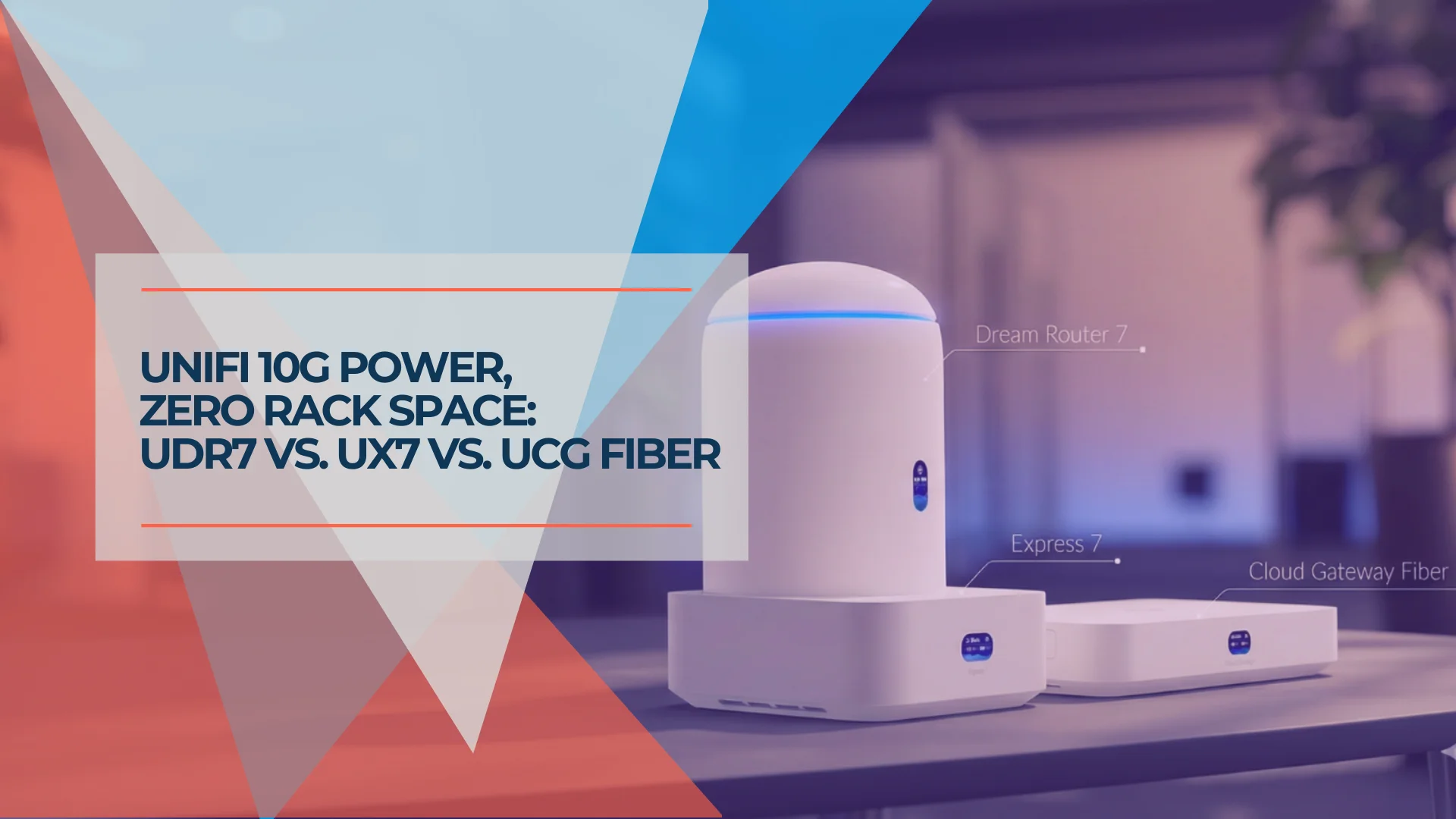
Which UniFi Gateway is Right for You? UDR7, UX7, or UCG Fiber
Compare the UniFi Dream Router 7 ($279), Express 7 ($199), and Cloud Gateway Fiber ($279+). Specs, use cases, and which compact gateway fits your network.
10 min read
UniFi Cloud Gateway Max Review (2026): Performance, Protect Limits, and Who Should Buy It
Hands-on UCG-Max review with verified 2026 pricing, IDS/IPS and VPN testing, Protect camera limits, thermals, storage guidance, and comparisons with UCG Fiber, UDR7, and UCG Ultra.
24 min read