

UniFi Cloud Gateway Max Review (2026): Performance, Protect Limits, and Who Should Buy It
Hands-on UCG-Max review with verified 2026 pricing, IDS/IPS and VPN testing, Protect camera limits, thermals, storage guidance, and comparisons with UCG Fiber, UDR7, and UCG Ultra.

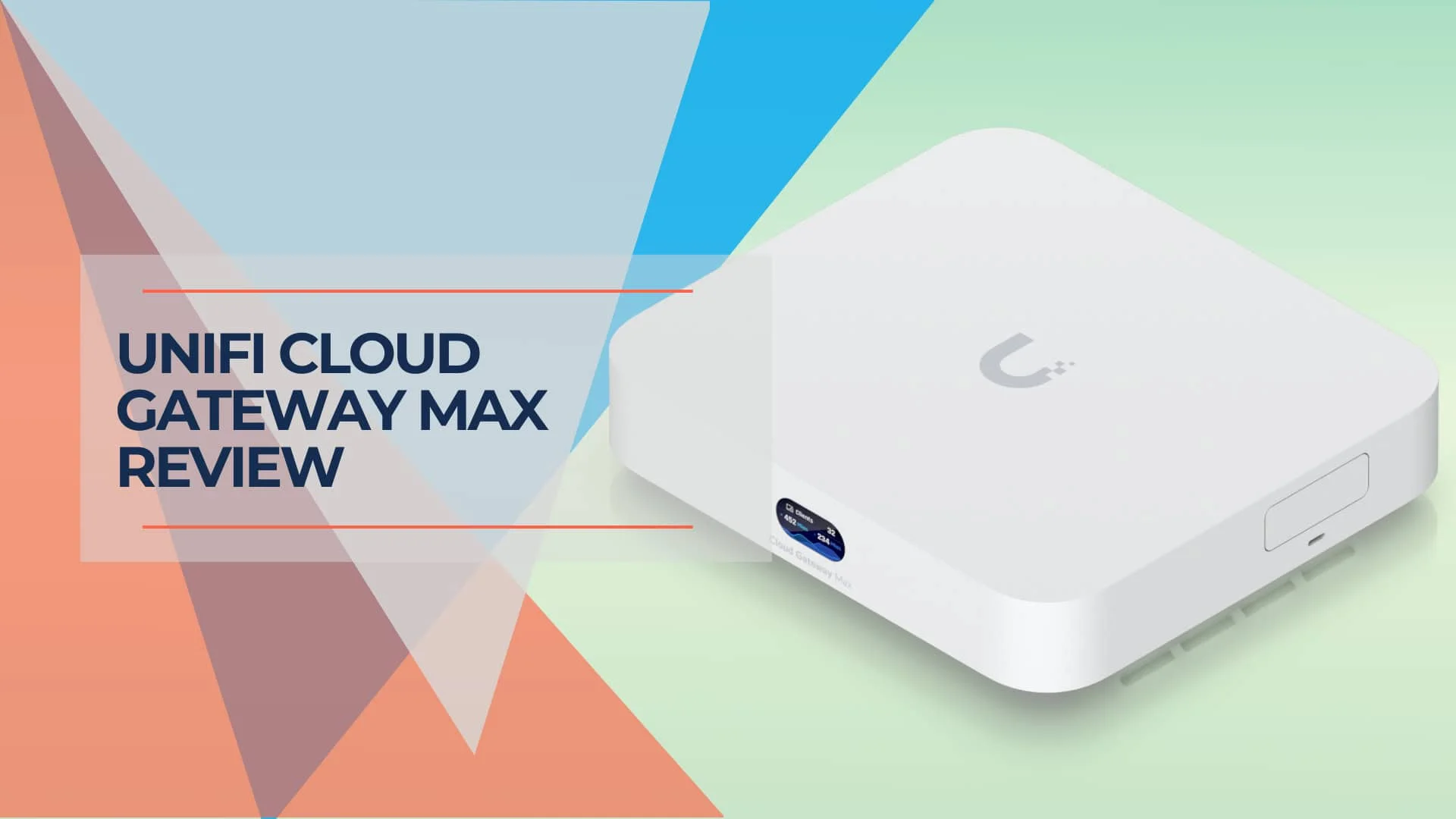
The UniFi Cloud Gateway Max is the gateway we recommend to most small business clients with internet plans below approximately 2 Gbps. Starting at $199 (no storage; US Store pricing checked July 2026, before tax and shipping), it delivers 2.3 Gbps IDS/IPS throughput, one 2.5 GbE WAN port plus four 2.5 GbE LAN ports, UniFi Protect support, and a full built-in controller — all in a fanless box that draws 16 watts.
The UCG-Max has been on the market since mid-2024. In our experience across dozens of client sites, the firmware has been stable and the platform has received meaningful updates — most significantly, the IDS/IPS throughput improvement to 2.3 Gbps and the zone-based firewall in UniFi Network 9.0. UniFi Network 10.5, released in June 2026, added PPPoE 1500-MTU support and further throughput-efficiency improvements.
This review covers verified specifications, our field measurements, deployment notes, and the specific scenarios where the UCG-Max is the right call — and where it isn't.
What Has Changed Since Launch (July 2026)
The UCG-Max has received several meaningful platform updates since this review was originally published in mid-2024:
- UniFi OS 4.1+: The current official IDS/IPS specification is 2.3 Gbps. Owners should run the current stable UniFi OS release.
- UniFi Network 9.0 — Zone-Based Firewall: The new firewall engine simplifies rule management significantly. If you are running legacy firewall rules on an existing UCG-Max, migrating to zone-based rules is worth the effort.
- UniFi Network 10.5 (June 2026): Added PPPoE 1500-MTU support (RFC 4638) and throughput-efficiency improvements for PPPoE connections. This is a meaningful update for ISPs requiring PPPoE authentication.
- G6 Camera Compatibility: Current G6 cameras are supported within the UCG-Max's Protect capacity (15 HD / 8 2K / 5 4K). No hardware change required to add G6 cameras to an existing Protect setup.
- CyberSecure pricing unchanged: The $99/year subscription remains current pricing as of July 2026, covering 55,000+ IPS signatures with real-time updates via Proofpoint.
Affiliate Disclosure: This article contains affiliate links. If you make a purchase through these links, we may earn a small commission at no extra cost to you. As an Amazon Associate, iFeelTech earns from qualifying purchases.
UCG-Max vs. 2026 Alternatives — Quick Decision Guide:
- Sub-2 Gbps internet + no built-in WiFi needed → UCG-Max (from $199)
- Need built-in WiFi 7 + all-in-one design → Dream Router 7 ($279)
- 10G backbone or PoE+ needed → UCG Fiber (from $279, no storage)
- Warehouse / extreme heat / harsh environment → UCG Industrial
UCG-MAX at a Glance: Key Numbers
| Spec | Value |
|---|---|
| Price | $199 (No Storage) / $279 (512GB) / 1TB / 2TB available |
| IDS/IPS Throughput | 2.3 Gbps |
| Ports | 5x 2.5 GbE RJ45 (1 default WAN + 4 LAN; up to 4 configurable as WAN) |
| Max Storage | Up to 2TB NVMe (M.2 slot) |
| Protect Camera Limit | 15 HD / 8 2K / 5 4K (processing limit, not storage) |
| Max Managed Devices | 30+ UniFi devices, 300+ clients |
| Processor | Quad-core ARM Cortex-A53 @ 1.5 GHz |
| Memory | 3 GB DDR4 |
| Power Draw | ~8–10W idle / 16.1W max, fanless |
| Enclosure | Polycarbonate, passive cooling |
| WiFi | None (wired gateway only) |
| Dimensions | 141.8 × 127.6 × 30 mm |
US Store pricing checked July 2026; before tax and shipping. The No Storage version requires a separate M.2 SSD Tray (~$19) to add storage later.
Verdict: Is the UCG-Max Worth Buying in 2026?
The UCG-Max is a strong fit for small offices with internet plans below approximately 2 Gbps, separate access points, and modest Protect requirements. It delivers 2.3 Gbps IDS/IPS throughput, one WAN plus four LAN 2.5 GbE ports, and up to 2TB NVMe storage for UniFi Protect — starting at $199 (no storage) or $279 (512GB). It is not the right choice when your internet exceeds 2 Gbps (consider the UCG Fiber from $279) or when you need integrated WiFi 7 (consider the Dream Router 7 at $279). The single-drive NVMe setup is convenient for small deployments but does not replace a dedicated NVR for higher camera counts or compliance-driven retention.
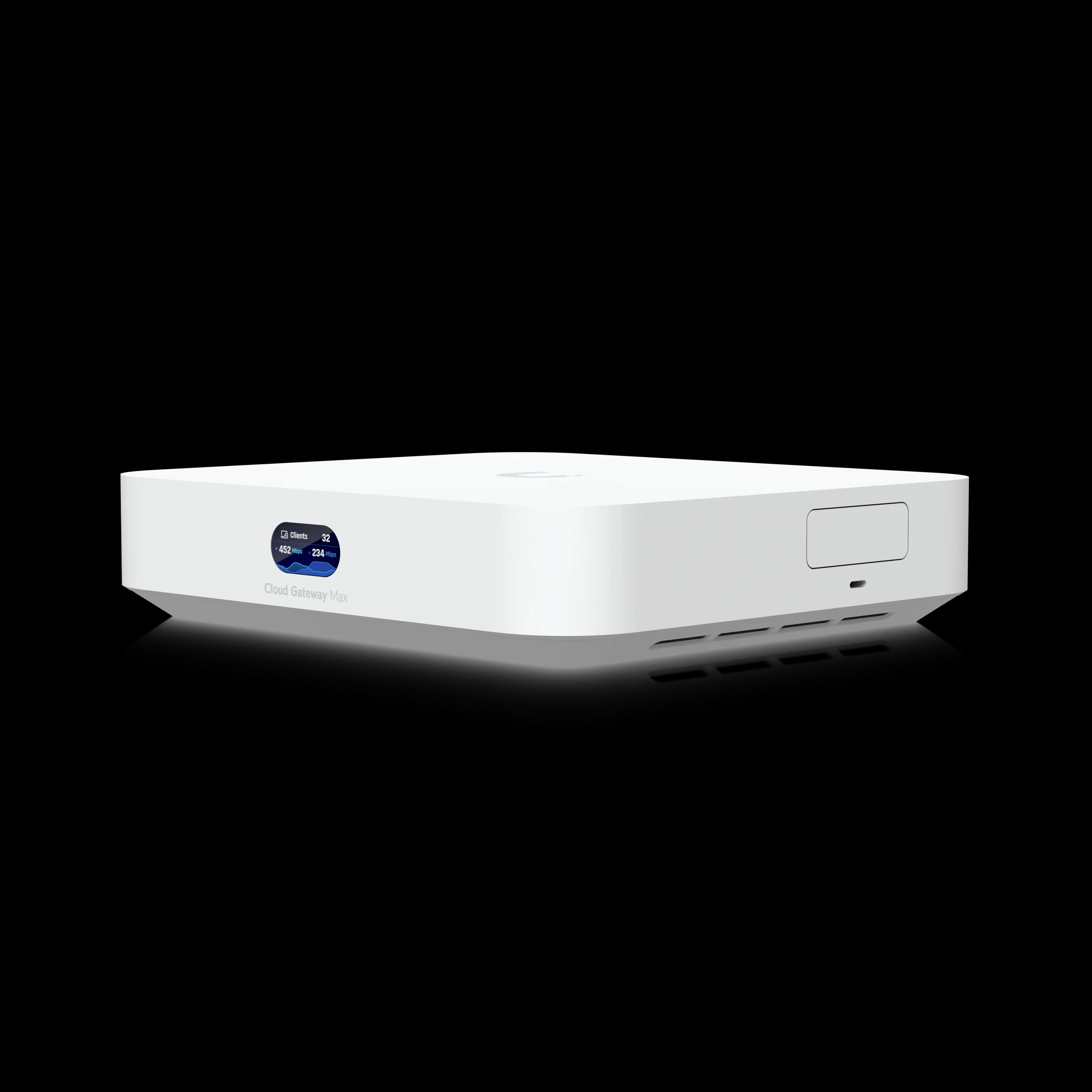
Cloud Gateway Max
Wired gateway for small offices with sub-2 Gbps internet and built-in UniFi Protect storage.
- 2.3 Gbps IDS/IPS throughput
- Up to 2TB NVMe storage for UniFi Protect
- 5x 2.5 GbE ports (1 WAN + 4 LAN)
- Fanless polycarbonate design
*Price at time of publishing
UCG-Max Hardware Specifications
The UCG-Max includes a 1.5 GHz quad-core ARM Cortex-A53 processor, 3 GB DDR4 RAM, five 2.5 GbE RJ45 ports (one default WAN, four LAN), and up to 2TB NVMe storage for UniFi Protect.
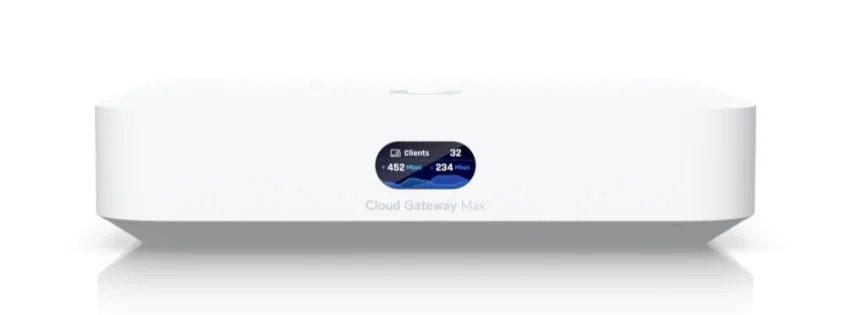
At 141.8 × 127.6 × 30 mm, this compact, fanless polycarbonate device draws approximately 8–10W at idle and a maximum of 16.1W under full load, powered by USB-C. It replaces the need for a separate Network Video Recorder (NVR) and cloud key, running the full UniFi ecosystem locally.
Integrated UniFi Ecosystem Support
The UCG-MAX runs the full UniFi ecosystem locally. It supports:
- UniFi Network: For managing network devices and traffic
- UniFi Protect: For video surveillance
- UniFi Talk: For VoIP communications
- UniFi Access: For access control systems
- UniFi Connect: For remote device management
All five applications run locally on the device, eliminating the need for a separate Cloud Key or controller.
High-Speed Networking Capabilities
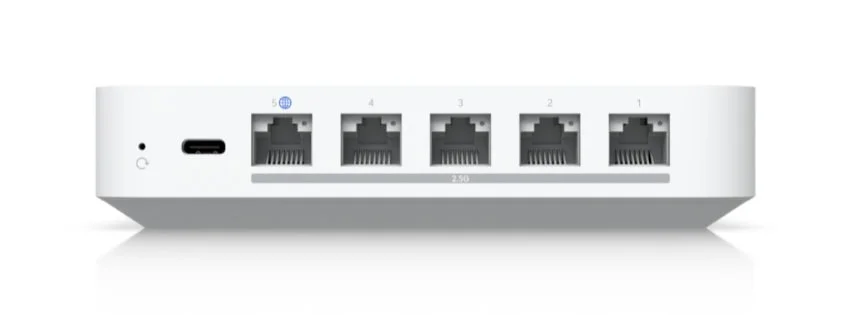
The device has five 2.5 GbE RJ45 ports:
- 1 x 2.5 GbE default WAN port
- 4 x 2.5 GbE LAN ports
The official specification supports up to four WAN ports total, meaning up to three LAN ports can be reconfigured as additional WAN connections for multi-WAN load balancing or failover. In our deployments, we typically use two WANs (primary fiber + cellular backup) and leave three ports as LAN.
All ports exceed standard Gigabit Ethernet by 2.5x. For businesses requiring 10Gbps uplinks, the UCG Fiber is the better fit.
Built-in Storage for Security Footage
The UCG-Max is available with no storage or with selectable 512GB, 1TB, or 2TB NVMe storage for UniFi Protect. According to Ubiquiti, this allows for:
- Up to 15 HD (1080p) cameras
- Up to 8 2K cameras
- Up to 5 4K cameras
The G6 camera series released in 2025, featuring enhanced 4K imaging and AI capabilities, pairs directly with the UCG-MAX's built-in NVR storage.
The UCG-MAX maintains a small physical footprint:
- Dimensions: 141.8 x 127.6 x 30 mm (5.6 x 5 x 1.2")
- Weight: 519 g (1.1 lb)
- Power method: USB Type-C (5V DC/5A)
- Power consumption: ~8–10W at idle / 16.1W maximum
The UCG-MAX is completely fanless and uses passive cooling through its polycarbonate enclosure, making it silent in operation. In our deployments, the external surface temperature typically stabilizes around 40–45°C (104–113°F) after several hours of sustained load with IDS/IPS and Protect recording active (measured in office environments with approximately 22–24°C ambient temperature). We have not observed CPU throttling, spontaneous restarts, or storage-health warnings at these temperatures. Avoid stacking it directly on top of cable modems or other heat-generating equipment, and leave at least a few centimeters of clearance on all sides. The compact design and USB-C power delivery make it easy to deploy on a desk, in a network closet, or wall-mounted.
USB-C power and UPS planning: The UCG-Max draws up to 16.1W via USB-C (5V/5A). Connect the supplied power adapter to a UPS-backed outlet. Ubiquiti also lists its PoE Integrated AC Adapter as an accessory for the UCG-Max. Plan for power continuity — a gateway restart interrupts both routing and Protect recording.
For deployments in warehouses, manufacturing floors, or outdoor-adjacent areas where temperatures exceed office range or dust is a factor, the UCG Industrial is the purpose-built alternative — the UCG-Max is designed for controlled office environments.
Watch: Ubiquiti's official introduction to UniFi Network 10
iFeeltech Field Notes: Where We Deploy the UCG-MAX
We are a Miami-based IT services firm. Since mid-2024, we have deployed the UCG-MAX across dozens of client locations, primarily offices with 5–30 employees and internet connections below 2 Gbps.
"The UCG-MAX is our default gateway recommendation for small offices without a dedicated IT closet. The compact form factor, USB-C power, and passive cooling let us install it on a desk, behind a monitor, or wall-mounted in a network closet. In our experience, the configuration workflow is the same as every other UniFi gateway. The only time we steer clients elsewhere is when they need 10G uplinks for the U7 Pro XGS or want cellular failover built in — then it's the UCG Fiber or Dream Router 5G Max."
— Nandor Katai, iFeeltech Network Engineer
Need help sizing your Protect storage or deciding between the UCG-Max and UCG Fiber for your office? Book a free 15-minute network audit with our Miami team.
Does the UCG-Max Support Multi-Gigabit Internet?
Yes, the UCG-Max supports multi-gigabit internet connections up to 2.5 Gbps via its dedicated 2.5 GbE WAN port.
Because all five ports operate at 2.5 GbE, the gateway handles multi-gigabit traffic without bottlenecking internal traffic. For 10 Gbps WAN connections — or deployments using WiFi 7 access points like the U7 Pro XGS that benefit from a 10 Gbps wired uplink when the design needs more than 2.5 Gbps of backhaul — the UCG Fiber is the better fit. If your internet plan is 1 Gbps or below and you don't need Protect, the Cloud Gateway Ultra ($129) handles that workload at a lower cost. For a direct comparison on throughput, cameras, and total cost, see our Cloud Gateway Ultra vs Cloud Gateway Max comparison.
What Is the UCG-Max Routing Speed?
The UCG-Max delivers 2.3 Gbps of routing throughput with IDS/IPS enabled, and 800 to 1,000 Mbps for WireGuard VPN connections.
The 2.3 Gbps IDS/IPS figure is the current official specification. For OpenVPN, higher CPU overhead drops speeds to 300–400 Mbps. In our client deployments prior to Network 10.5, ISPs requiring PPPoE authentication typically achieved 950 Mbps to 1.1 Gbps. UniFi Network 10.5 (June 2026) added PPPoE 1500-MTU support (RFC 4638) and throughput-efficiency improvements — we recommend updating and retesting if you are on an earlier version.
Gateway Throughput Comparison
How does the UCG-MAX stack up against the 2025-2026 gateway lineup?
| Specs | |||
|---|---|---|---|
| IDS/IPS Throughput | 2.3 Gbps | 2.3 Gbps | 5 Gbps |
| Ports | 5x 2.5 GbE RJ45 | 1x 10G SFP+, 1x 2.5G WAN, 3x 2.5G LAN | 2x 10G SFP+, 1x 10G RJ45, 4x 2.5G RJ45 |
| Storage | Up to 2TB NVMe | 64GB microSD | Up to 2TB NVMe (sold separately) |
| Protect Cameras | 15 HD / 8 2K / 5 4K | 5 HD / 2 2K / 1 4K | 15 HD / 8 2K / 5 4K |
| WiFi | None | WiFi 7 Tri-Band | None |
| PoE | None | 1x PoE | 1x PoE+ (30W) |
For offices with internet connections up to 2 Gbps, the UCG-MAX handles routing and security without becoming a bottleneck. Networks requiring 10Gbps uplinks should look at the UCG Fiber.
Our Field Measurements
The following figures are from our deployments and should be treated as representative of our test conditions rather than guaranteed product specifications. The official UCG-Max IDS/IPS specification is 2.3 Gbps per Ubiquiti's tech specs.
| Scenario | Throughput | Notes |
|---|---|---|
| IDS/IPS routing (official spec) | 2.3 Gbps | Ubiquiti-rated specification |
| VPN (WireGuard) | 800–1,000 Mbps | UCG-Max VPN server, macOS/Windows client over LAN |
| VPN (OpenVPN) | 300–400 Mbps | UCG-Max VPN server, macOS/Windows client over LAN |
| PPPoE (pre-Network 10.5) | 950 Mbps–1.1 Gbps | See methodology below |
How We Tested
VPN measurements used iPerf3 from a macOS or Windows laptop connecting to the UCG-Max's built-in WireGuard or OpenVPN server, with traffic sent to a wired 2.5 GbE LAN host on a separate routed VLAN. The gateway was running UniFi OS 4.x and Network 9.x (pre-10.5) with IDS/IPS enabled at default signature levels. PPPoE results are from client sites with 1 Gbps fiber plans using ISP-provided modems in bridge mode. Test durations were 60-second runs with three repetitions averaged. We plan to retest PPPoE throughput on Network 10.5 with 1500-MTU support.
PPPoE Users: ISPs using PPPoE typically see 950 Mbps to 1.1 Gbps on the UCG-Max (measured prior to Network 10.5). Configure your modem in bridge mode and let the UCG-Max handle PPPoE authentication directly. Update to Network 10.5 or later for 1500-MTU support.
Processing Power and Memory
The UCG-MAX is equipped with:
- Quad-core ARM Cortex-A53 processor running at 1.5 GHz
- 3 GB DDR4 system memory
- Selectable NVMe storage up to 2TB (no storage, 512GB, 1TB, or 2TB)
This hardware handles network traffic, security cameras, access control, and VoIP for environments with up to 30+ UniFi devices and 300+ clients.
Multi-WAN and Failover
The UCG-Max supports up to four WAN ports total (the official specification), though the default configuration uses one WAN and four LAN. In practice, most deployments reconfigure one LAN port as a secondary WAN for failover or load balancing. The remaining three ports then serve as LAN. Failover is automatic. This works with cable, fiber, Starlink, or an external LTE/5G modem. Note that each port reassigned to WAN reduces available LAN ports. The UniFi 5G Backup ($99) is the most affordable cellular failover option — it connects to any PoE switch port without using a WAN port. See our 5G failover setup guide for configuration steps.
UniFi Protect Performance
The UCG-MAX doubles as a small-scale NVR. Ubiquiti's official recommendation is up to 15 HD cameras, 8 2K cameras, or 5 4K cameras — regardless of storage size. Larger storage extends retention, not camera capacity. The UCG-Max is compatible with current G6 cameras within these limits.
CPU load under combined workloads: In one mixed-load deployment, five 4K recordings combined with sustained multi-gigabit inspected traffic pushed CPU utilization above 80%. Actual utilization varies by camera model, encoding settings, recording mode, and traffic volume. Reducing to three 4K streams provided comfortable CPU headroom for concurrent high-throughput routing in that environment. Deployments needing more cameras should add a dedicated recorder such as the UNVR rather than relying on a larger SSD in the UCG-Max.
Storage and Retention Guidance
How long can you store footage? The UCG-Max's processing capacity is capped at 15 HD / 8 2K / 5 4K regardless of drive size. Larger drives extend retention, not camera count.
Retention varies considerably by camera model, resolution, frame rate, compression quality, encoding, and recording mode (continuous vs. motion-only). Use Ubiquiti's Capacity Calculator with your planned cameras and settings before selecting a drive. See our UniFi Protect storage planning guide for additional context.
The UCG-Max uses a single NVMe drive with no RAID — it is convenient for modest office surveillance but is not equivalent to a redundant recorder. Businesses with longer retention requirements, higher camera counts, or recording-compliance obligations should consider a dedicated UNVR or ENVR.
Total System Cost: Realistic Configurations
Gateway price alone does not determine total cost. Here are representative configurations to help compare apples-to-apples:
| Configuration | Components | Approx. Total |
|---|---|---|
| UCG-Max without Protect | UCG-Max NS ($199) | $199 |
| UCG-Max with Protect | UCG-Max 512GB ($279) | $279 |
| UCG-Max office starter | UCG-Max 512GB ($279) + Lite 8 PoE switch (~$109) + U7 Pro AP (~$189) | ~$577 |
| UCG Fiber equivalent | UCG Fiber NS ($279) + M.2 Tray ($19) + 512GB NVMe (~$40–60) | ~$338–358 |
| UDR7 equivalent | UDR7 ($279) — integrated WiFi 7 and PoE eliminate separate AP and switch for small spaces | $279 |
All prices are US Store as of July 2026, before tax and shipping. Third-party NVMe SSDs can be used in the UCG Fiber's M.2 slot; Ubiquiti also sells pre-configured storage options.
UCG-MAX Built-In Network Security Features
The UCG-MAX provides an application-aware firewall, VLAN segmentation, and 2.3 Gbps Intrusion Detection and Prevention (IDS/IPS). It natively supports content filtering and site-to-site VPNs, with optional CyberSecure ($99/year) integration for real-time threat intelligence powered by Proofpoint.
Intrusion Detection and Prevention System (IDS/IPS)
The UCG-MAX includes both Intrusion Detection System (IDS) and Intrusion Prevention System (IPS) capabilities:
- Detects and blocks potential network threats in real-time
- Operates at speeds up to 2.3 Gbps (with UniFi OS 4.1+), minimizing impact on network performance
For comparison, the UCG Fiber reaches up to 5 Gbps IDS/IPS throughput for networks that need more headroom.
Application-Aware Firewall
The UCG-Max's firewall operates at the application layer — not just by port number. You can permit Zoom and block Dropbox on the same network, or restrict Spotify on guest VLANs while leaving business applications unrestricted. This is configured via Traffic Rules in UniFi Network, no CLI required.
Content Filtering and CyberSecure
The UCG-MAX includes built-in content filtering:
- Blocks access to inappropriate or harmful websites
- Customizable filtering rules to align with company policies
- Support for Ubiquiti's CyberSecure subscription service (powered by Proofpoint)
The UCG-MAX is compatible with CyberSecure ($99/year), which adds real-time threat intelligence and enhanced URL filtering. Larger enterprise gateways support CyberSecure Enterprise ($499/year), but for most small business deployments the standard tier covers the essentials. Combined with UniFi Identity VPN, the UCG-Max provides a network perimeter security layer for under $300/year. Note that this covers network-level protections — it does not replace endpoint security, identity management, email filtering, or security operations tooling.
VLAN Support and Network Segmentation
The UCG-Max supports multiple isolated networks with IPS enforcement active across all of them. Each VLAN can have its own firewall zone, DNS filtering policy, and traffic-shaping profile — configured through the zone-based firewall introduced in UniFi Network 9.0. For a practical overview of which VLANs most small businesses need, see our VLAN segmentation guide.
Integrated Security with UniFi Protect
When paired with UniFi Protect cameras, the UCG-MAX adds:
- Smart detection capabilities for identifying people, vehicles, and license plates
- Secure storage of video footage on selectable NVMe storage (512GB, 1TB, or 2TB)
- Compatibility with the new G6 camera series and enhanced AI features
The G6 PTZ camera and other 2025 releases add pan-tilt-zoom tracking and improved AI detections, all managed through the UCG-MAX's Protect interface.
UCG-Max Setup and Configuration Workflow
The UCG-Max is configured locally using the built-in UniFi Network application, requiring under ten minutes via web browser or mobile app.
The workflow is identical to managing any previous Dream Machine or Cloud Key. What is specific to managing the UCG-Max:
- Protect storage management: The built-in NVMe drive appears as a local Protect recording target. You can monitor drive health, adjust retention policies per camera, and switch between continuous and motion-only recording directly from the Protect dashboard.
Pro Tip: Swapping the NVMe Drive Erases All Footage
If you upgrade the UCG-Max's NVMe drive to a larger capacity after deployment, all recorded footage is permanently erased in the process. Decide on your storage tier at purchase time — the 512GB, 1TB, or 2TB options — and save the swap headache later.
- UniFi OS updates: The current official IDS/IPS specification is 2.3 Gbps. Keep the gateway on a current stable release and schedule updates during a maintenance window, since gateway updates temporarily interrupt routing and Protect recording. Update manually via Settings > System > Firmware.
- Zone-Based Firewall (Network 9.0+): The newer firewall engine simplifies rule creation compared to the legacy interface. If your UCG-MAX is still running older firewall rules, migrating to the zone-based model is worth the effort for cleaner configuration.
- Site-Magic SD-WAN: For multi-site deployments, the UCG-MAX supports Ubiquiti's Site-Magic mesh VPN. This is configured at the site level in the UniFi portal and requires no additional licensing.
Should You Upgrade from the USG to the UCG-Max?
Yes — upgrading from a USG to the UCG-Max increases IDS/IPS throughput from 85 Mbps to 2.3 Gbps and adds built-in NVR storage for cameras.
If you are running a USG, USG-Pro, or first-generation Dream Machine, here is a full comparison:
| USG / USG-Pro | Dream Machine (UDM) | UCG-MAX | |
|---|---|---|---|
| IDS/IPS Throughput | ~85 Mbps (USG) / ~250 Mbps (Pro) | ~850 Mbps | 2.3 Gbps |
| Port Speed | 1 GbE | 1 GbE | 2.5 GbE |
| Built-in NVR | No | No | Yes (NVMe, up to 2TB) |
| UniFi OS | Legacy controller | UniFi OS 1.x | UniFi OS 4.x |
| WiFi | No | Built-in WiFi 5 | No |
| Form Factor | Rack / desktop | Desktop (cylindrical) | Compact desktop |
Note: The original UDM is a WiFi 5 desktop gateway without a drive bay. The UDM-Pro (rack-mount) has a 3.5" HDD bay and should be compared separately. If you are upgrading from a UDM-Pro, the UCG Fiber is a closer successor.
The biggest practical gains are IDS/IPS speed (from too slow for modern broadband plans with IPS enabled on the USG, to 2.3 Gbps on the UCG-MAX) and integrated NVR storage. If you were running a Cloud Key Gen2 Plus alongside your USG for Protect recording, the UCG-MAX consolidates both into one device.
When to skip the UCG-MAX and go straight to the UCG Fiber or UDR7: If your current internet plan exceeds 2 Gbps or you are planning a deployment that benefits from 10G uplinks, the UCG-MAX's 2.5 GbE ports will become a bottleneck. The UCG Fiber starts at $279 (no storage) and provides 10G SFP+ and 10 GbE RJ45 ports.
Pros and Cons: 2026 Perspective
Pros
-
Production Track Record: On the market since mid-2024 with consistent firmware updates. In our deployments, we have experienced stable performance across client sites.
-
Flexible Pricing: Starts at $199 (no storage) or $279 (512GB), with 1TB and 2TB NVMe options.
-
All-in-One Form Factor: Router, firewall, VPN gateway, and NVR in a single fanless box — fewer devices to manage, power, and troubleshoot.
-
2.3 Gbps IDS/IPS: Matches the UDR7's security throughput, sufficient for most small business connections below 2 Gbps.
-
Network Perimeter Security: IDS/IPS, application-aware firewall, content filtering, and optional CyberSecure ($99/year) without needing a separate security appliance. Does not cover endpoint, identity, or email security.
-
Built-In NVMe Storage: Configurable NVMe storage for UniFi Protect eliminates a separate recorder for small deployments (up to 15 HD / 8 2K / 5 4K cameras). The NVMe drive offers higher write endurance than the UDR7's microSD card for continuous 24/7 recording workloads.
Cons
-
No Integrated WiFi: Unlike the UDR7 and Express 7, the UCG-MAX doesn't include built-in WiFi, requiring separate access points for wireless networking.
-
No 10Gbps Ports: The UCG-MAX's 2.5 GbE ports limit upgrade potential compared to the UCG Fiber's 10G SFP+ and 10 GbE RJ45 ports.
-
No Built-in PoE: Unlike the UDR7 (1x PoE) and UCG Fiber (1x PoE+), the UCG-MAX has no PoE ports — you'll need a separate PoE switch or injectors for access points and cameras.
-
Single-Drive Recording: The UCG-Max uses a single NVMe drive with no RAID. If the drive fails, all footage is lost. This is acceptable for modest office surveillance but not for compliance-driven or mission-critical recording.
-
Camera Capacity Ceiling: The 15 HD / 8 2K / 5 4K limit is a processing constraint, not a storage constraint. Larger drives extend retention but do not raise this ceiling. Deployments needing more cameras require a dedicated UNVR or ENVR.
-
NS Version Requires Sled Purchase: If you buy the $199 "No Storage" version, you must separately purchase the NVMe sled accessory (~$19) to add storage later.
-
Updates Interrupt Service: Firmware and application updates restart both routing and Protect recording. Plan maintenance windows accordingly.
2025-2026 Gateway Landscape: How the UCG-MAX Compares
Ubiquiti expanded its gateway lineup in 2025 with 10-gigabit models, WiFi 7 integration, and PoE support. For a full overview of the current UniFi product lineup, see our UniFi buyer's guide. Here is how each option compares to the UCG-MAX.
Find the Right UniFi Gateway
Not sure which UniFi gateway fits your deployment? Use our interactive tool to get a recommendation:
UniFi Gateway Selector
Answer a few questions to find your ideal gateway
Recommended Gateway
Based on your requirements
Need help choosing? Get a free consultation
Dream Router 7 (UDR7)
Dream Router 7
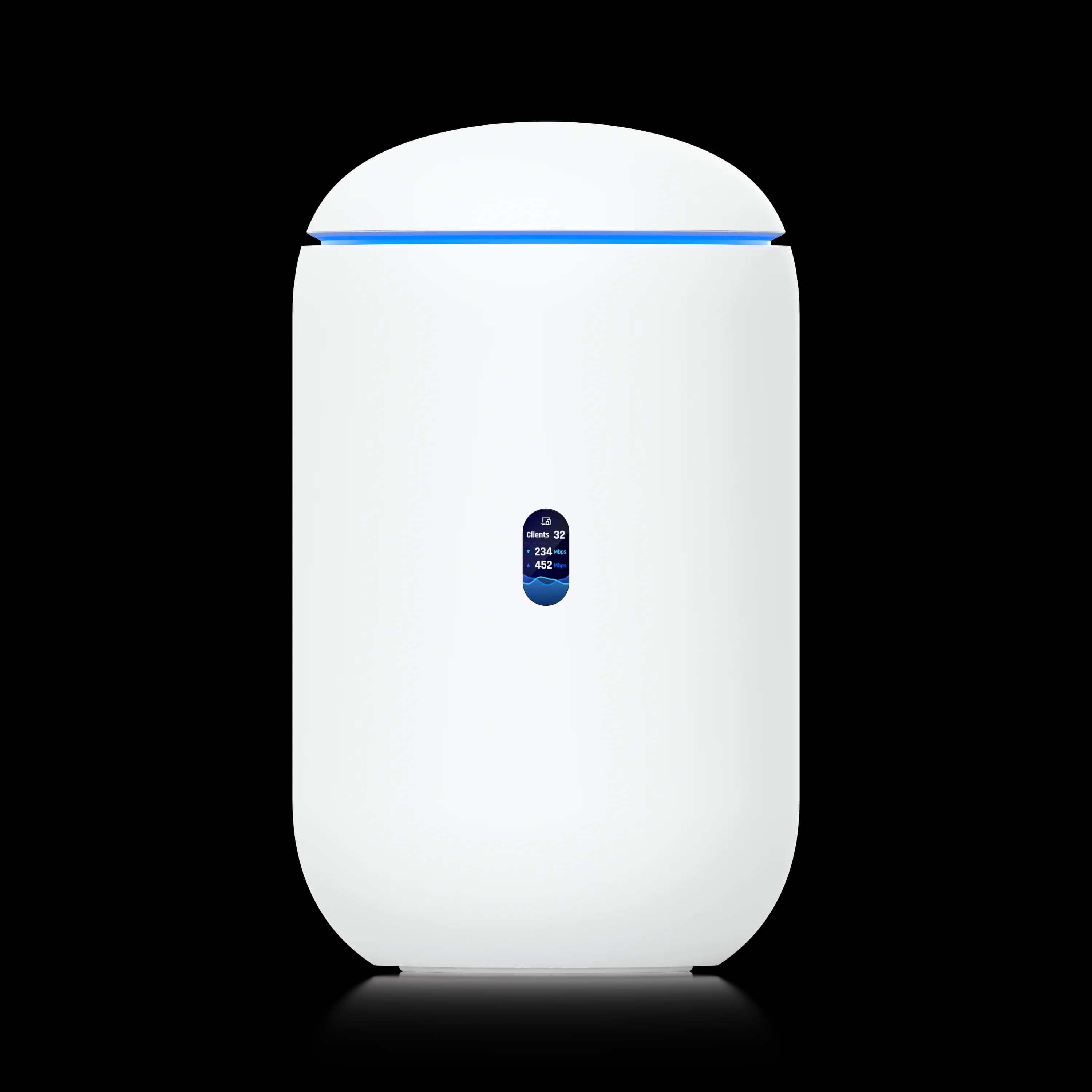
$279Integrated tri-band WiFi 7 gateway with 1x PoE port, 10G SFP+ WAN, and 64GB microSD storage.
The UDR7 is a compact WiFi 7 gateway with integrated tri-band wireless, a 10G SFP+ WAN port, a 2.5 GbE RJ45 WAN port, three 2.5 GbE LAN ports (including 1x PoE port for powering a single AP), and 64GB microSD storage. It offers 2.3 Gbps IDS/IPS throughput and supports up to 300 simultaneous users. The right pick when you need WiFi 7 built-in and an all-in-one design. Note that its IDS/IPS specification remains 2.3 Gbps — the 10G SFP+ port is useful for ISP handoff, not for 10 Gbps routing with security enabled.
Note on Protect storage endurance: The UDR7's included 64GB Western Digital Purple microSD is rated for surveillance use, but microSD cards have inherently lower write endurance than NVMe SSDs under continuous 24/7 recording. Ubiquiti's own UDR7 manual recommends using a "high-endurance microSD card designed for continuous recording" if you upgrade capacity. For deployments requiring persistent 24/7 4K recording, the UCG-Max's NVMe SSD is the more reliable long-term choice.
Cloud Gateway Fiber (UCG Fiber)
Cloud Gateway Fiber
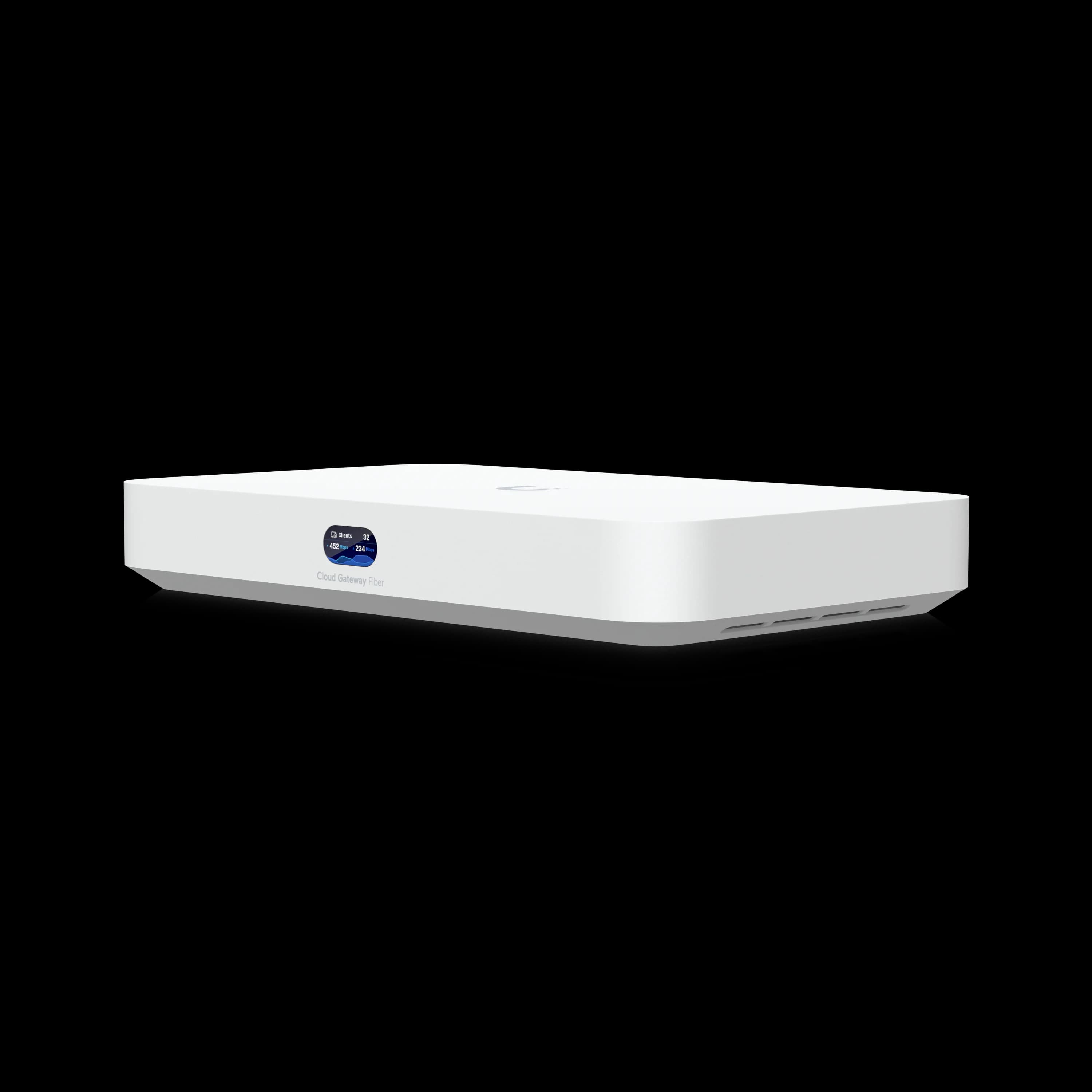
From $279 (no storage)10G wired gateway with 2x 10G SFP+, 1x 10 GbE RJ45, 4x 2.5 GbE, PoE+, and up to 2TB NVMe storage.
The UCG Fiber expands on the UCG-MAX concept with two 10G SFP+ ports, one 10 GbE RJ45 port, four 2.5 GbE RJ45 ports, and 5 Gbps IDS/IPS throughput. It includes M.2 NVMe storage support (up to 2TB) and 1x PoE+ port (802.3at, 30W). At $279 (no storage), the base price matches the UCG-MAX 512GB — but storage is not included and must be purchased separately. Both consoles share the same Protect camera limits (15 HD / 8 2K / 5 4K). The UCG Fiber is the better choice for networks targeting 2.5+ Gbps internet or needing 10G uplinks — it is a routing and port-speed upgrade, not a camera-capacity upgrade. Deployments exceeding Protect capacity should add a dedicated UNVR. See our full UCG Fiber review for detailed specs and deployment guidance.
For other gateways in the current lineup — including the Express 7 ($199, WiFi 7 mesh node), Dream Router 5G Max ($499, built-in 5G cellular), and UCG Industrial (ruggedized) — see our UniFi buyer's guide or the UCG Industrial review.
When to Choose Each Gateway
2026 Gateway Recommendation Guide
Choose the UCG-MAX if:
- You have existing WiFi 6 or WiFi 7 access points and don't need built-in wireless
- Your internet plan is below approximately 2 Gbps (the 2.3 Gbps IDS/IPS ceiling covers most SMB fiber plans)
- You need UniFi Protect with built-in NVMe storage for a small camera deployment (up to 15 HD / 8 2K / 5 4K)
- You want a platform that has been in production since mid-2024 with consistent firmware updates
Consider the UDR7 if:
- You want integrated WiFi 7 and an all-in-one design for a smaller space
- You prefer a single device with a built-in PoE port for one access point
- You need a 10G SFP+ WAN handoff from your ISP (note: IDS/IPS throughput remains 2.3 Gbps)
Consider the UCG Fiber if:
- You need 10 Gbps port speeds for backbone connectivity or U7 Pro XGS uplinks
- Your internet plan exceeds 2 Gbps and you need 5 Gbps IDS/IPS throughput
- You want PoE+ (30W) built into the gateway
Consider the UCG Industrial if:
- You need a ruggedized, fanless gateway for harsh environments (warehouses, manufacturing, outdoor-adjacent)
- There is no IT closet or rack space — the Industrial wall-mounts with built-in WiFi 7 and 270W PoE
- You want a single all-in-one device (router + WiFi + PoE switch) for satellite locations
Is the UCG-MAX the Right Gateway in 2026?
The UCG-MAX makes the most sense when your priorities are cost, NVR integration, and a compact wired gateway for an office with internet below approximately 2 Gbps, separate access points, and modest Protect requirements. It handles 2.3 Gbps IDS/IPS, supports up to 15 HD / 8 2K / 5 4K cameras on built-in NVMe storage, manages 300+ clients, and runs silently on 16 watts. In our experience since mid-2024, the firmware has been stable across client deployments.
At $199 (no storage) or $279 (512GB), it covers the core requirements for small office deployments without needing additional hardware beyond access points and a PoE switch. However, it uses a single NVMe drive with no redundancy, has no built-in PoE or WiFi, and its 2.5 GbE ports will not scale to 10G networks.
When to look elsewhere: If your internet plan exceeds 2 Gbps, the UCG Fiber (from $279, no storage) offers 5 Gbps IDS/IPS and 10G ports. If you want integrated WiFi 7 in a single device, the Dream Router 7 ($279) is the cleaner solution. If you need more cameras than the 15/8/5 limit, add a dedicated UNVR rather than upgrading the gateway.
For a real-world example of the Cloud Gateway Max deployed in a home, see our residential UniFi installation case study — a 2,500 sq ft retrofit on existing Cat5e with four U7 In-Wall APs and the 512GB storage option. If you're evaluating the UCG Max alongside non-UniFi options like Firewalla, Omada, or subscription firewalls, our best firewall for small business guide compares the full landscape with TCO breakdowns.
Frequently Asked Questions
Is the UCG-MAX worth buying in 2026?
For small and medium offices with internet below approximately 2 Gbps, yes. The UCG-MAX delivers 2.3 Gbps IDS/IPS throughput, built-in NVMe storage for UniFi Protect, and manages 300+ clients in a $199 fanless device. In our experience, the firmware has been stable since the OS 4.1+ update in late 2024. It is not the right choice for internet plans above 2 Gbps (consider UCG Fiber) or when you need integrated WiFi 7 (consider Dream Router 7).
UCG-MAX vs UCG Fiber: which should I buy?
The UCG Fiber starts at $279 (no storage) — the same price as the UCG-MAX 512GB. Its key advantages: two 10G SFP+ ports, one 10 GbE RJ45 port, four 2.5 GbE RJ45 ports, one PoE+ port, and 5 Gbps IDS/IPS throughput. Both consoles share the same Protect camera limits (15 HD / 8 2K / 5 4K). Choose the UCG-MAX if your internet plan is under 2 Gbps and you want NVMe storage included in the base price. Choose the UCG Fiber if your plan exceeds 2 Gbps or you need 10G uplinks for access points like the U7 Pro XGS.
How many cameras can the UCG-MAX run?
Ubiquiti's official recommendation is 15 HD cameras, 8 2K cameras, or 5 4K cameras — regardless of storage size. The storage tier determines retention duration, not camera capacity. On the 512GB model, plan for 5–8 cameras at 1080p with 7–14 days of retention. Upgrading to 1TB or 2TB extends retention but does not raise the console's processing capacity above the 15/8/5 limit. Deployments needing more cameras should add a dedicated UNVR.
Can I upgrade the storage later on the UCG-MAX?
Yes, but with limitations. The UCG-MAX uses an M.2 NVMe slot. If you purchased the "No Storage" (NS) version, you'll need to buy the NVMe sled separately (sold by Ubiquiti, ~$19). If you have a pre-installed drive, you can replace it with a larger NVMe SSD up to 2TB. Note that replacing the drive will erase all stored Protect footage.
Does the UCG-MAX support WiFi 7 access points?
Yes, the UCG-MAX can manage WiFi 7 access points like the U7 Pro and U7 Pro Max. However, the UCG-MAX's maximum port speed is 2.5 Gbps, so WiFi 7 access points that benefit from 10 Gbps wired backhaul (like the U7 Pro XGS) will not reach their full potential. For designs that need a 10 GbE uplink to a U7 Pro XGS, consider the UCG Fiber together with an appropriate 10 GbE PoE switch or injector.
What's the difference between UCG-MAX and UXG-Max?
The UCG-MAX is a Cloud Gateway that runs the full UniFi OS locally, including UniFi Network, Protect, Talk, Access, and Connect. The UXG-Max is an Independent Gateway that requires an external UniFi controller (like a Cloud Key or self-hosted). The UCG-MAX also includes NVMe storage and a display screen, while the UXG-Max does not.
Is the UCG-MAX fanless? How loud is it?
Yes, the UCG-MAX is completely fanless with passive cooling through its polycarbonate enclosure and is silent in operation. In our deployments, the external surface temperature stabilizes around 40–45°C after several hours of sustained load in office environments. We have not observed throttling or restarts. See the hardware specifications section above for placement recommendations.
Can I use the UCG-MAX with a 5G/LTE modem for backup internet?
Yes. The UCG-Max supports up to four WAN ports total. In practice, configure one LAN port as a secondary WAN for failover or load balancing and connect your 5G/LTE modem (Starlink, cellular hotspot, etc.) to it. The UCG-MAX will automatically fail over when the primary connection drops. For integrated 5G, see the Dream Router 5G Max ($499).
Related Articles
More from UniFi Networks
UniFi Gateway Comparison Guide 2026: All 11 Models Ranked
Complete UniFi gateway comparison covering all 11 current models — from Cloud Gateway Ultra ($129) to Dream Machine Beast ($1,499) and Enterprise Fortress Gateway ($1,999). Exact device counts, throughput thresholds, and storage economics.
26 min read
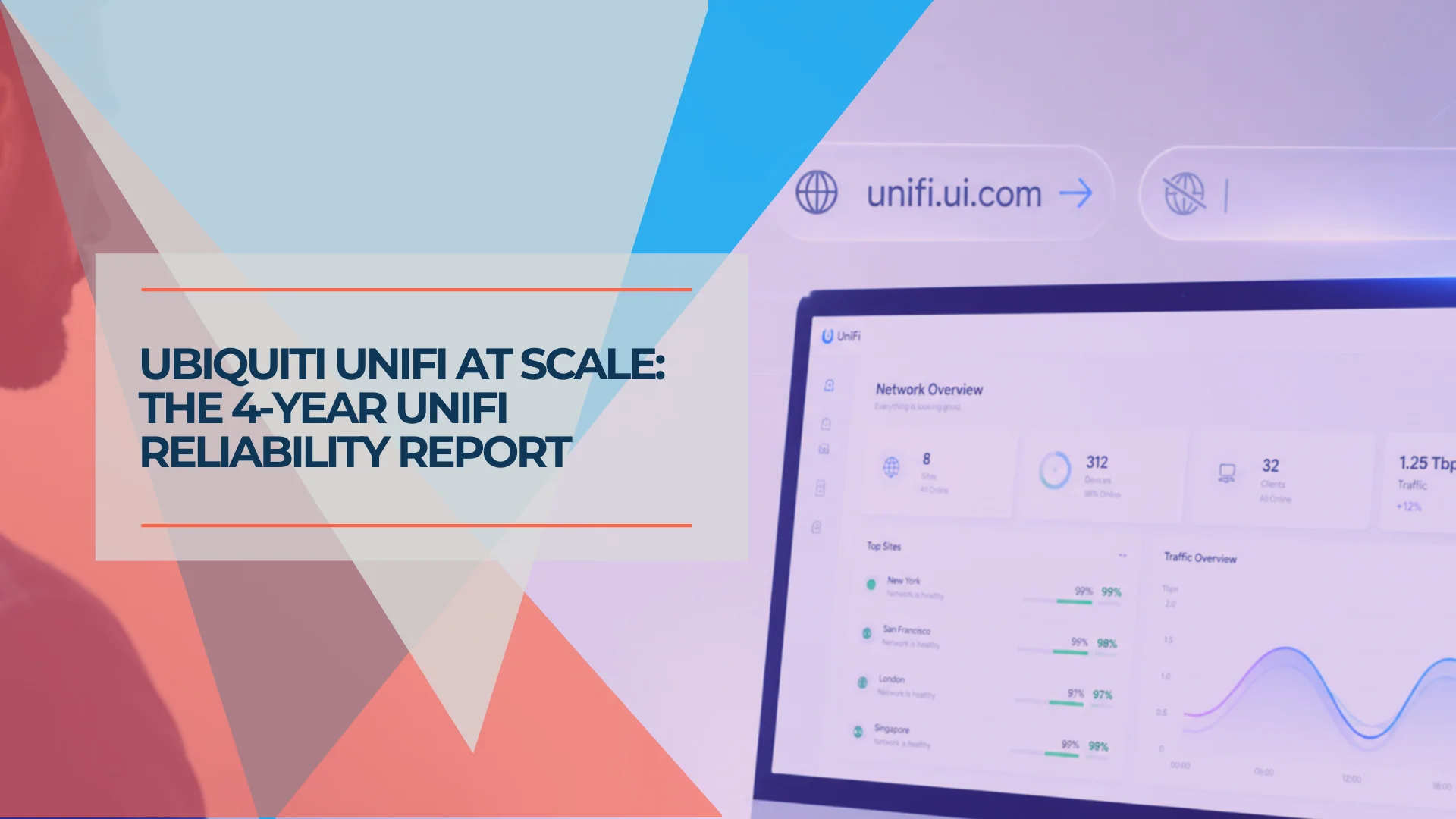
We Ran 538 Ubiquiti Devices for 4 Years. Here's What Actually Failed.
Real fleet data: 538 UniFi devices tracked over 4 years. 0.74% replacement rate, 99.99% core uptime, and five incident post-mortems from commercial sites.
15 min read

UniFi UCG Industrial Review: When the Ruggedized Chassis Justifies the Price
Full UCG Industrial review with verified specs, real-world deployment, and comparison to the UCG Fiber. $579 buys a fanless, ruggedized WiFi 7 gateway with 270W PoE — here's when it makes sense.
16 min read