

What Network Gear IT Contractors Actually Buy for Small Business Jobs (2026)
The actual kit list an IT contractor uses for small business network installs in 2026 — Cat6, patch panel, UniFi gateway decision, PoE switching, XG/XGS APs, and UPS. With the real reasoning behind each choice.

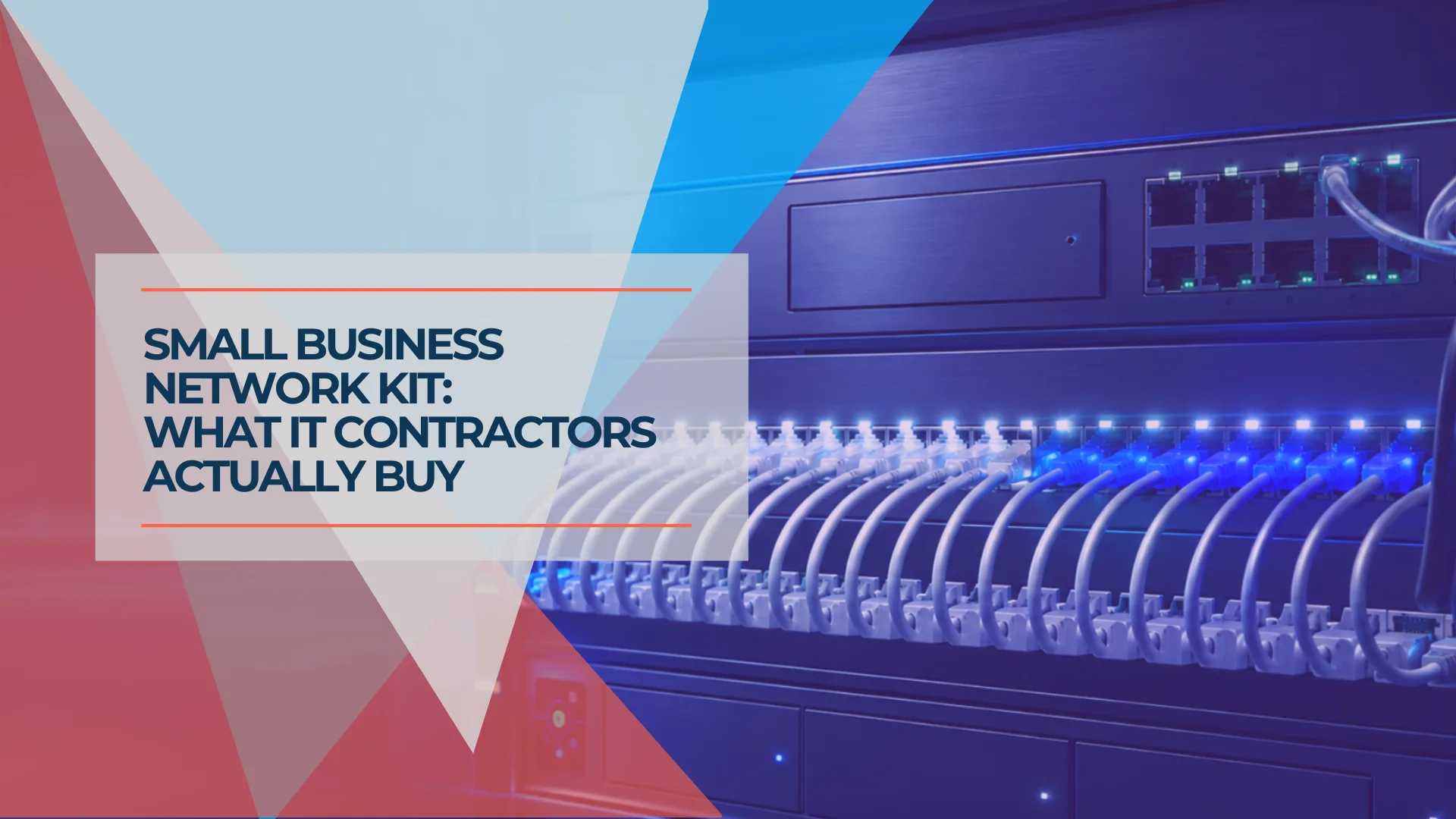
When I show up to a small business network job, the gear I pull from the van is almost always the same. This combination provides reliable scaling across dozens of South Florida installs, from a 10-person office to a 60-person multi-floor space, and every component does exactly what it's supposed to do.
This is the actual kit list I was running as of May 2026 — the specific equipment I recommend to clients, buy for jobs, and stand behind.
If you're a small business owner trying to understand what a professional network install should include — or an IT contractor putting together your own standard kit — here's what the baseline looks like.
Affiliate Disclosure: This article contains affiliate links. If you make a purchase through these links, we may earn a small commission at no extra cost to you. As an Amazon Associate, iFeelTech earns from qualifying purchases.
The Standard Kit: What Goes Into Every Job
Before I walk through the reasoning behind each piece, here's the full list. Every item below ships on every standard small business install I do. The specifics — which gateway, how many access points, how many switch ports — vary by job, but the categories never do.
| Category | Model | Why It's in the Kit |
|---|---|---|
| Cabling | Cat6A for AP uplinks, Cat6 for desktops + labeled patch panel | 10G-capable infrastructure that matches the APs |
| Rack / Shelf | Wall-mount IT rack or dedicated shelf | Clean gear mounting, airflow, and cable management |
| Gateway | Cloud Gateway Fiber or UDM Pro Max | Routing, firewall, and UniFi controller — model depends on the install |
| DAC Cable | 10G SFP+ Direct Attach Cable (0.5–1m) | Connects the gateway's SFP+ port to the switch backbone — $13–$15 |
| PoE Switch | UniFi Pro Max 24 PoE or Pro XG 24 PoE | Multi-gig ports to feed 10 GbE APs + power for cameras, VoIP, and access control |
| Access Points | UniFi U7 Pro XG or U7 Pro XGS | WiFi 7 with 10 GbE uplinks for future-proof wireless |
| UPS | APC or CyberPower (750VA minimum) | Power protection for everything in the rack |
If you want the full walkthrough on how a network install comes together, the small business network setup guide covers the process end to end. This article is specifically about the gear decisions — what I buy and why.
The rest of this article goes through each category, with the reasoning behind every choice.
What Cabling and Infrastructure Does a Small Business Network Need?
Cat6A cabling for access point uplinks, Cat6 for desktop drops, a labeled patch panel, and a properly mounted rack or shelf form the physical foundation that every other component depends on.
I've walked into offices where the previous contractor ran Cat5e through ceiling tiles with no cable management, terminated directly into wall jacks with zero slack, and didn't label a single run. Troubleshooting that network two years later costs more than the original install.
Why Cat6A for AP uplinks
Since we're installing U7 Pro XG and XGS access points with 10 GbE uplinks, the cabling to those APs needs to support 10 Gbps. Cat6 only supports 10 Gbps up to 55 meters — and in a real building with bundled cable runs through conduit, that effective distance drops further due to alien crosstalk. Cat6A supports 10 Gbps at the full 100-meter channel length, handles PoE++ heat loads better with its larger conductors, and eliminates distance concerns entirely.
For a new install where you're already pulling cable through walls and ceilings, running Cat6A to AP locations costs roughly 20–30% more per drop than Cat6 ($200–$350 per drop vs. $150–$250). That's a small premium for infrastructure that won't bottleneck a $299 access point for the next decade.
Desktop drops still get Cat6. No desktop device in a typical office needs 10 Gbps to the workstation, and Cat6 handles gigabit reliably at the full 100-meter distance. Cat6 CMR-rated cable runs $160–$200 per 1,000-foot box.
| Cable Type | 10G Distance | Cost per 1,000 ft (CMR) | Use Case |
|---|---|---|---|
| Cat6 | Up to 55m | $160–$200 | Desktop drops, VoIP phones, cameras |
| Cat6A | Full 100m | $250–$350 | AP uplinks, backbone runs, future-proof drops |
A note on cable ratings: The prices above are for CMR (riser-rated) cable. Most commercial office spaces with drop ceilings that serve as air return plenums require CMP (plenum-rated) cable by fire code. Plenum-rated cable costs more — typically $250–$350 per 1,000-foot box for Cat6 and $350–$500 for Cat6A. Verify the local building code requirements for your space before ordering materials; using riser cable in a plenum space is a code violation.
Every cable run terminates at a patch panel in the rack, not directly into devices. That means every port is labeled, every connection is documented, and when something needs to change — a desk moves, a camera gets added, a VoIP phone gets swapped — the change happens at the patch panel, not behind a wall plate.
The rack itself depends on the space. If the client has a server closet or a utility room with wall space, a small wall-mount rack (6U–12U) keeps everything organized. If there's no dedicated room, a lockable wall-mount enclosure or even a clean shelf with proper cable management works. The goal is the same: keep the gear off the floor, ventilated, and accessible.
The labeling rule
Label every cable run at both ends during the install — not after. Test every run with a cable tester before connecting it to equipment. The 20 minutes you spend labeling and testing during the install saves hours of tracing cables when a port goes dead 18 months later. For a deeper look at the cabling layer, the Cat6 vs. fiber business cabling guide covers the full decision.
Which UniFi Gateway Is Best for a Small Business?
The UDM Pro Max is best for rack-mount setups with security cameras, while the Cloud Gateway Fiber is ideal for rackless, network-only installs. Both deliver identical 5 Gbps IPS routing throughput.
The decision between these gateways relies on physical infrastructure rather than pure specifications, as both the Cloud Gateway Fiber (UCG-Fiber, $279) and the UDM Pro Max (UDM-Pro-Max, $599) run the full UniFi OS stack — Network, Protect, Access — with no recurring licensing fees.
| Feature | Cloud Gateway Fiber ($279) | UDM Pro Max ($599) |
|---|---|---|
| Form factor | Desktop | 1U rack-mount |
| IPS routing | 5 Gbps | 5 Gbps |
| LAN ports | 4x 2.5 GbE (integrated) | 8x 1 GbE |
| SFP+ ports | 1x 10G | 2x 10G |
| NVR storage | Selectable (NVMe slot) | 2x 3.5" SATA drive bays + 128 GB SSD |
| Max UniFi devices | ~60 | 200+ |
| High availability | No | Yes (Shadow Mode) |
Both gateways connect to the PoE switch via a 10G SFP+ Direct Attach Cable (DAC) — a short passive copper cable that plugs into the SFP+ ports on each device. A 0.5m DAC costs $13 on the Ubiquiti Store. It's one of the cheapest items in the kit, but it's the physical backbone link that carries all traffic between routing and switching, so don't forget to include it in your bill of materials.
The decision rule
Choose the UDM Pro Max for environments with a dedicated IT rack. The dual drive bays make it the natural home for Protect NVR storage, and the 10G SFP+ uplinks future-proof the backbone.
Choose the Cloud Gateway Fiber for space-constrained installations. It operates quietly as a desktop unit, and the integrated 2.5 GbE switch ports reduce component count for smaller installs.
The rack question decides the gateway before the spec sheet does.
Why not the UDM-SE? The Dream Machine Special Edition ($499) sits between these two with 8 built-in PoE ports and 180W of PoE budget. It's a capable unit, but I leave it out of the standard kit for a specific reason: its 3.5 Gbps IPS throughput is lower than both the Cloud Gateway Fiber and UDM Pro Max (both 5 Gbps), and I prefer pairing the gateway with a dedicated PoE switch that's sized to the job's exact wattage requirements. The UDM-SE's built-in switch is convenient, but it locks you into a fixed port count and PoE budget that may not match the install.
One edge case worth noting: if the client plans to add UniFi Protect cameras and wants local NVR recording, the UDM Pro Max's dedicated drive bays make it the stronger pick regardless of rack availability. But for a network-only install without cameras, the Cloud Gateway Fiber does the job at half the cost.
Introducing: UniFi Dream Machine Pro Max
One of the biggest reasons I standardize on UniFi: there are no recurring per-device licensing fees. You buy the hardware once, and the management software — UniFi Network Application — is included indefinitely. Cisco Meraki, the main enterprise alternative, requires $150–$500 per device per year in mandatory licensing, and hardware stops passing traffic if that license lapses. For a 25-person office, that licensing difference adds up to $6,000–$20,000+ over five years. The UniFi vs. Meraki WiFi 7 cost comparison breaks down the full total cost of ownership.
One caveat worth noting: Ubiquiti does offer an optional CyberSecure subscription ($99/yr) that enhances the gateway's built-in IDS/IPS with a curated Proofpoint threat signature database (70,000+ signatures on the UDM Pro Max and UCG-Fiber) and Cloudflare-powered content filtering with 100+ domain categories. It's entirely optional — the gateway's core IDS/IPS engine works without it — but for clients who want enterprise-grade threat intelligence without a separate security appliance, it's a reasonable add-on at a fraction of what competing platforms charge for equivalent functionality.
Check current UDM Pro Max availability →
Why Is a PoE Switch Required for Small Business Networks?
A PoE switch delivers power and data over a single Ethernet cable to APs, cameras, VoIP phones, and access control hardware. The switch manages the power budget centrally, and any device can be rebooted remotely by cycling its port from the UniFi controller.
Why the switch matters as much as the AP
Since the U7 Pro XG and XGS access points have 10 GbE uplinks, the switch feeding them needs multi-gig ports. Plugging a 10 GbE access point into a standard 1 GbE switch port throttles that AP to one-tenth of its uplink capacity. For a future-proof install, the switch needs to match the infrastructure you're building.
Three factors determine switch selection:
- Port speed — does the switch have 2.5G or 10G ports to feed your APs at full capacity?
- PoE budget (watts) — the total power the switch can deliver across all PoE ports simultaneously
- Port count — how many devices you need to connect (add 20–30% headroom for growth)
PoE Planning Tool
PoE Budget Calculator
Add the PoE devices you plan to connect — see your total wattage and which switch covers your load with 30% headroom.
U7 Pro XGS
29W · PoE++
U7 Pro XG
22W · PoE+
IP Camera
15W · PoE
VoIP Phone
8W · PoE
Access Control
12W · PoE
Add your devices above to calculate total PoE wattage and get a switch recommendation.
A U7 Pro XGS draws up to 29W (PoE++). A U7 Pro XG draws up to 22W (PoE+). A standard IP camera draws 12–15W. A VoIP phone draws 6–8W. If you're running 3 APs, 4 cameras, and 8 VoIP phones, that's roughly 87W + 60W + 56W = 203W of PoE demand.
Here's where the UniFi multi-gig PoE switches land for small business installs:
| Model | Multi-Gig Ports | PoE Budget | Price | Best For |
|---|---|---|---|---|
| Pro Max 24 PoE | 8x 2.5 GbE PoE++ / 16x 1 GbE / 2x 10G SFP+ | 400W | $799 | Standard installs — 2.5G to APs, 10G SFP+ backbone |
| Pro XG 24 PoE | 16x 10 GbE PoE+++ / 8x 2.5 GbE / 2x 25G SFP28 | 720W | $1,799 | Full future-proof — native 10G to every AP and camera |
My default switch recommendation
For most small business installs, the Pro Max 24 PoE ($799) is the right pick. Its 8x 2.5 GbE PoE++ ports deliver 2.5 Gbps to each AP — more than enough for current WiFi 7 client throughput — and the 2x 10G SFP+ uplinks connect cleanly to the gateway backbone. The 400W PoE budget handles 4 APs, a handful of cameras, and VoIP without strain.
If budget allows and you want true 10 Gbps to every access point, the Pro XG 24 PoE ($1,799) provides full 10G to every port. Its 16x 10 GbE PoE+++ ports mean every AP runs at full uplink speed, and the 720W budget provides significant headroom for growth. This is the switch for installs where the network needs to last 7–10 years without revisiting the switching layer.
What about the Standard and Pro switches? The Standard 24 PoE ($379) and Pro 24 PoE ($699) only have 1 GbE access ports. They work for VoIP phones and cameras, but they limit a U7 Pro XG or XGS to 1 Gbps on the uplink — which means the AP's 10 GbE port goes unused. If you're spec'ing WiFi 7 APs with 10G uplinks, the switch should match that capability.
PoE budget matters as much as port speed
Always add up the wattage of every PoE device you plan to connect — then buy the switch that covers that number with at least 30% headroom. Running at 100% PoE budget increases the risk of hardware failure and system reboots when all devices draw power simultaneously on cold boot.
The UniFi ecosystem advantage here is unified management. The gateway, switch, and APs all appear in the same controller, with the same dashboard, the same alerting, and the same remote management. That's a real operational benefit — especially for IT contractors managing 20+ client networks.
Check current UniFi Pro Max 24 PoE availability →
Which UniFi Access Points Should a Small Business Install in 2026?
The UniFi U7 Pro XG ($199) and U7 Pro XGS ($299) are the recommended WiFi 7 access points for permanent small business installs, providing 6 GHz support and 10 GbE uplinks.
Both are WiFi 7 (802.11be) access points designed for ceiling-mount deployment in commercial spaces.
The difference between them: the XGS adds a dedicated spectral scanning radio that continuously monitors the RF environment for interference, and it has 8 spatial streams instead of 6. For most small business installs, the XG handles the load without issue. But for denser environments — open floor plans with 40+ wireless devices, or offices adjacent to other businesses on shared spectrum — the XGS's spectral scanning pays for itself in fewer interference-related support calls.
Why WiFi 7 for a small business?
The pushback I hear most often: "WiFi 6 is good enough — why pay for WiFi 7?"
Fair question if you're buying equipment for your house that you'll replace in three years. But a business install is different. The access points I put in today will be in the ceiling for 5–7 years. The laptops, phones, and tablets connecting to them are already shipping with WiFi 7 radios. By 2028, most client devices in a typical office will be WiFi 7-capable, and they'll perform better on a WiFi 7 AP that can use the full 6 GHz band with wider channels and multi-link operation.
Installing WiFi 6 APs today for a permanent business network means the hardware won't take advantage of 6 GHz spectrum or multi-link operation as client devices upgrade over the next several years.
| Feature | U7 Pro XG ($199) | U7 Pro XGS ($299) |
|---|---|---|
| WiFi standard | WiFi 7 (802.11be) | WiFi 7 (802.11be) |
| Spatial streams | 6 | 8 |
| 6 GHz support | Yes | Yes |
| Spectral scanning radio | No | Yes (dedicated) |
| Uplink | 1/2.5/5/10 GbE | 1/2.5/5/10 GbE |
| Coverage area | ~1,500 ft² | ~1,750 ft² |
| Max client devices | 300+ | 500+ |
| Max power draw | 22W (PoE+) | 29W (PoE++) |
For a typical 2,500–5,000 sq ft office, 2–3 access points provide full coverage with seamless roaming. A 10,000 sq ft multi-floor space might need 4–6 depending on layout and wall construction.
These APs need multi-gig switching and Cat6A uplinks
Both the U7 Pro XG and XGS have a 10 GbE uplink port. Connecting them to a 1 GbE switch port throttles the AP to one-tenth of its uplink capacity. At minimum, use a switch with 2.5 GbE PoE ports (like the Pro Max 24 PoE) and run Cat6A cable to each AP location. For full 10 Gbps uplink speed, the Pro XG 24 PoE provides native 10G RJ45 PoE ports.
My default recommendation
For most small business installs, I spec the U7 Pro XGS ($299). The spectral scanning radio significantly reduces interference-related WiFi troubleshooting, and the 8-stream throughput handles future growth. At $100 more than the XG per access point, the operational savings pay for the upgrade within the first year. For very small offices (under 1,500 sq ft) with light wireless demand, the U7 Pro XG at $199 is still a strong choice.
Introducing: UniFi U7 Pro XG and XGS
Check current U7 Pro XGS availability →
For clients who need to understand the broader picture on future-proofing their network backbone, the multi-gig network upgrade guide covers the switch and uplink side of the equation.
Does a Small Business Network Rack Need a UPS?
Yes — a UPS (uninterruptible power supply) protects the gateway, switch, and NVR from power surges and provides battery backup for graceful shutdown during outages.
The UPS is the first item clients ask to cut from the quote. I understand why — it doesn't do anything visible, and it's easy to see it as insurance you won't need. But a power surge during a summer thunderstorm that damages a $599 gateway and corrupts NVR recordings costs far more than the UPS would have.
Don't skip the UPS
A UPS is not optional on any install I do. A power fluctuation that damages or corrupts a gateway costs the client far more in downtime and replacement hardware than the $150–$400 the UPS would have cost. This is especially true in South Florida, where we regularly lead the country in lightning strikes — a UPS with surge protection isn't just a power outage precaution, it's the primary defense against surge damage in a region where it happens routinely.
What the UPS actually does in a network rack:
- Surge protection — absorbs voltage spikes before they reach the gateway, switch, and any attached NVR drives
- Battery backup — keeps the network running for 10–30 minutes during an outage, depending on load and battery size
- Graceful shutdown — gives the gateway time to write configs and the NVR time to close recordings cleanly, rather than shutting down abruptly during a write operation
Sizing the UPS
The rule is simple: add up the wattage of everything plugged into the UPS and buy a unit rated for at least 1.5x that number. A typical small business rack — one gateway, one PoE switch, maybe a small NAS — draws 100–200W total. A 750VA/500W UPS covers that with room to breathe.
For most installs, I use an APC Smart-UPS (750VA or 1500VA) or a CyberPower equivalent. The APC Smart-UPS line gives clean sine wave output, which matters for networking gear that's sensitive to modified sine wave power. A CyberPower CP1500PFCLCD is a solid alternative at a lower price point if budget is tight.
If the rack is larger — multiple switches, a dedicated NVR, a server — step up to 1500VA and consider a rack-mount UPS (2U) for cleaner cable management.
For full rack builds (12U+), I also add a rack-mount PDU (power distribution unit). A basic horizontal PDU runs $30–$80 and gives you individual switched outlets, clean cable routing along the rack rail, and — on managed models — the ability to remotely power-cycle individual devices. It's not a mandatory item for a small wall-mount rack, but for any dedicated IT closet with 4+ powered devices, it pays for itself in cable management alone.
A few rack accessories that don't show up on hardware spec sheets but matter on install day: slim-run patch cables (6-inch to 2-foot lengths for patch panel to switch connections), velcro cable ties for bundle management, and cage nuts with screws for rack-mount equipment. Budget $50–$100 for a complete set. These small items make the difference between a rack that stays organized and one that becomes difficult to maintain over time.
How Much Does a Small Business Network Installation Cost?
A standard 15-person office network costs $4,350 to $6,500 installed, while a 60-person full rack build ranges from $7,800 to $14,600. Hardware is only one factor — cabling labor typically represents 40–60% of the total project cost.
These are realistic ballpark ranges, not fixed quotes. The final number depends on the number of cable runs, AP count, whether the client needs cameras, and how much labor the space requires.
Smaller install (10–15 person office, shelf or small rack, 2 APs)
| Component | Approximate Cost |
|---|---|
| Cabling: Cat6 desktop drops + Cat6A AP uplinks + patch panel (15–20 runs, labor included) | $1,800–$3,000 |
| Wall-mount rack or shelf + cable management | $150–$400 |
| Cloud Gateway Fiber | $279 |
| 10G SFP+ DAC Cable | $13 |
| Pro Max 24 PoE Switch | $799 |
| 2x UniFi U7 Pro XGS | $598 |
| UPS (750VA) | $150–$300 |
| Patch cables, velcro ties, cage nuts | $50–$100 |
| Hardware subtotal | $3,839–$5,489 |
| Configuration, testing, and documentation | $500–$1,000 |
| Total installed | $4,350–$6,500 |
Full rack build (30–60 person office, dedicated IT closet, 4 APs)
| Component | Approximate Cost |
|---|---|
| Cabling: Cat6 desktop drops + Cat6A AP uplinks + patch panel (30–50 runs, labor included) | $3,500–$7,000 |
| Floor-standing or wall-mount rack (12U–18U) | $300–$800 |
| UDM Pro Max | $599 |
| 10G SFP+ DAC Cable | $13 |
| Pro Max 24 PoE Switch (or Pro XG 24 PoE at $1,799 for full 10G) | $799–$1,799 |
| 4x UniFi U7 Pro XGS | $1,196 |
| UPS (1500VA) | $300–$500 |
| Rack-mount PDU | $30–$80 |
| Patch cables, velcro ties, cage nuts | $50–$100 |
| Hardware subtotal | $6,787–$12,087 |
| Configuration, testing, documentation, and project management | $1,000–$2,500 |
| Total installed | $7,800–$14,600 |
The biggest variable in both scenarios is cabling labor. The hardware is the part you can price out on a product page. The cabling — running through walls, ceilings, conduit, and fire-rated pathways — is where the labor hours stack up. In my experience, cabling and labor typically represent 40–60% of the total project cost. The hardware is often the smaller piece.
As a reference point: professional Cat6 cable runs typically cost $150 to $250 per drop installed, while Cat6A runs cost $200 to $350 per drop. Both include cable, termination, patch panel port, labeling, and testing. That cost moves higher for plenum-rated pathways, after-hours scheduling, or difficult physical access (concrete ceilings, long conduit runs). Per-drop cost generally decreases on larger projects due to labor efficiency — a 40-drop job runs cheaper per drop than a 10-drop job.
These are ballpark ranges, not quotes
Every install is different. A second-floor office with concrete ceilings and no existing conduit costs more to cable than a ground-floor suite with drop ceilings. Permit requirements vary by jurisdiction. These ranges are meant to help you sanity-check a proposal — if someone quotes $2,000 for a full 30-person office build with 4 APs, something is being left out.
For a more detailed estimate based on your specific office size and requirements, use the managed IT cost calculator.
What Does a Standard Network Install NOT Include?
The kit list above covers a clean, reliable, fully managed network baseline. It's not the ceiling. Here's what a standard install does not include by default:
Advanced cloud security appliances. For clients who need DNS-level threat filtering, ad blocking, or intrusion detection beyond what the UniFi gateway provides, I add a Firewalla or configure third-party DNS filtering. That's a separate conversation based on the client's risk profile.
Multi-WAN, cellular failover, or BGP routing. The standard install assumes a single ISP connection with the UniFi gateway handling NAT and firewall. For businesses where connectivity uptime is critical, adding a cellular backup (such as the UniFi LTE Backup or a dedicated 5G failover device) is an increasingly common add-on — but it's scoped and priced separately. Full dual-WAN with two ISPs or BGP peering adds routing complexity beyond the baseline.
Full Protect camera NVR deployments. If the UDM Pro Max is in the rack, it can serve as the NVR — but the camera hardware, licensing, placement design, and conduit runs are a separate project from the network infrastructure. I scope camera systems independently so the network budget stays clean.
Managed WiFi for guest or tenant isolation. The standard kit includes a guest SSID with VLAN isolation, but multi-tenant WiFi management (separate billing, bandwidth caps per tenant, captive portals) is a configuration layer that goes beyond the baseline install.
Each of these adds cost and complexity. The standard kit is intentionally kept to what every small business needs on day one — a network that's fast, secure, manageable, and built to grow without replacing core components.
Related Resources
- Why No-Name Networking Gear Raises Security Risk — The reasoning behind why we standardize on known brands and vet every piece of hardware before it touches a client network.
- Small Business Network Setup Guide — The full end-to-end walkthrough on building a small business network from scratch.
- Cat6 vs. Fiber: Business Cabling Guide — When Cat6 is the right call and when fiber makes sense for business infrastructure.
- UniFi vs. Meraki WiFi 7 Cost Comparison — Total cost of ownership comparison if you're evaluating ecosystem alternatives.
- Multi-Gig Network Upgrade Guide — Future-proofing your network backbone with multi-gig switching and uplinks.
Frequently Asked Questions
Related Articles
More from Network Infrastructure
Dual WAN for Business: Why One Internet Connection Isn't Enough
Why a single ISP is a single point of failure, how to verify real route diversity, and which dual-WAN gateway and backup connection fit a rack network or a simple branch office.
19 min read
How Often Should You Replace Your Router? The Security Signs We Look For on Every Job
Forget the 'every 3–5 years' rule. Here's the field checklist we run on a client's router before replacing it — plus what 4 years of fleet data says about how long networking gear actually lasts.
12 min read

VLANs Without the Jargon: What They Are, What to Separate, and Why It Matters
A plain-language guide to VLANs for small business owners. Understand what network segments you already need — guest WiFi, IoT cameras, VoIP phones — and what belongs in each one.
11 min read