

UNVR vs UNVR Pro vs UNVR G2: Which UniFi NVR Should You Buy in 2026?
Complete comparison of UniFi UNVR vs UNVR Pro network video recorders, plus the new 2026 UNVR G2 and G2 Pro. Compare specs, storage, RAID options, stacking, and total cost to choose the right NVR for your surveillance system.

Key Takeaway — June 2026 Update
Ubiquiti released two second-generation NVRs in May 2026: the UNVR G2 ($699) with 30 4K camera capacity and built-in AI analytics, and the UNVR G2 Pro ($999) with 8 bays and 50 4K camera capacity. For new deployments, the G2 models are the current recommendation. The original UNVR ($299) and UNVR Pro ($499) remain in the Ubiquiti Store but are older hardware. The rest of this comparison covers the full Gen 1 and Gen 2 lineups.
Quick Verdict
New deployment in 2026? Buy the UNVR G2 ($699) for up to 30 4K cameras with built-in AI analytics, or the UNVR G2 Pro ($999) for 8-bay, 50 4K camera capacity. The Gen 1 UNVR is older hardware; new deployments should start with the G2.
Evaluating existing Gen 1 hardware? The UNVR ($299) supports 18 4K cameras and 4 drive bays; the UNVR Pro ($499) supports 24 4K cameras and 7 drive bays. Both support RAID 5 and RAID 10. For 50+ cameras, consider the Enterprise NVR (ENVR).
Start here: If you are planning a new install, compare the UNVR G2, G2 Pro, ENVR, and ENVR Core. If you are managing an existing Gen 1 system, compare the UNVR vs UNVR Pro and decide whether upgrading to G2 is worth it.
2026 Buyer Decision Table
| Situation | Recommended Model |
|---|---|
| New install, under 30 4K cameras | UNVR G2 ($699) |
| New install, 30–50 4K cameras | UNVR G2 Pro ($999) |
| Existing Gen 1 system, under 15 cameras | Keep or buy UNVR ($299) |
| Existing Gen 1 system, needs retention or RAID flexibility | UNVR Pro ($499) |
| 50+ cameras | ENVR ($1,999) |
| Large campus or very high camera count | ENVR Core ($4,999) |
Prices and availability checked against the Ubiquiti US Store on June 23, 2026. Some models (notably the G2 Pro and ENVR Core) may show as sold out depending on region and inventory.
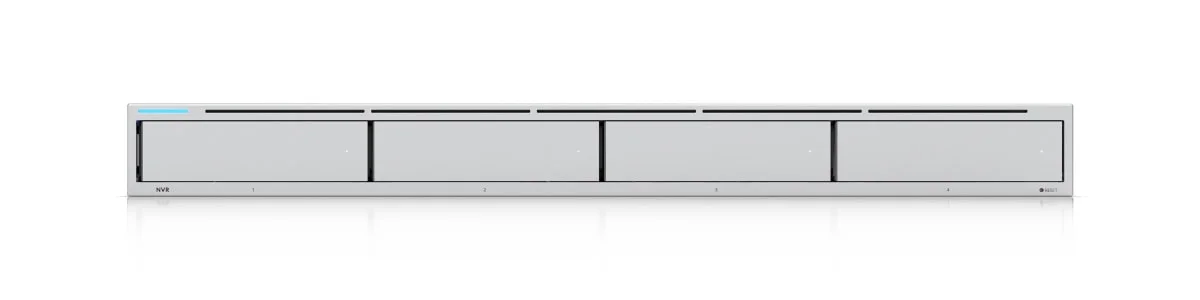
UniFi UNVR G2
Current-gen 4-bay NVR with 30 4K camera capacity, built-in Edge AI, and HDMI ViewPort.
- 30 4K Cameras
- Edge AI
- HDMI ViewPort
- 10G SFP+
*Price at time of publishing
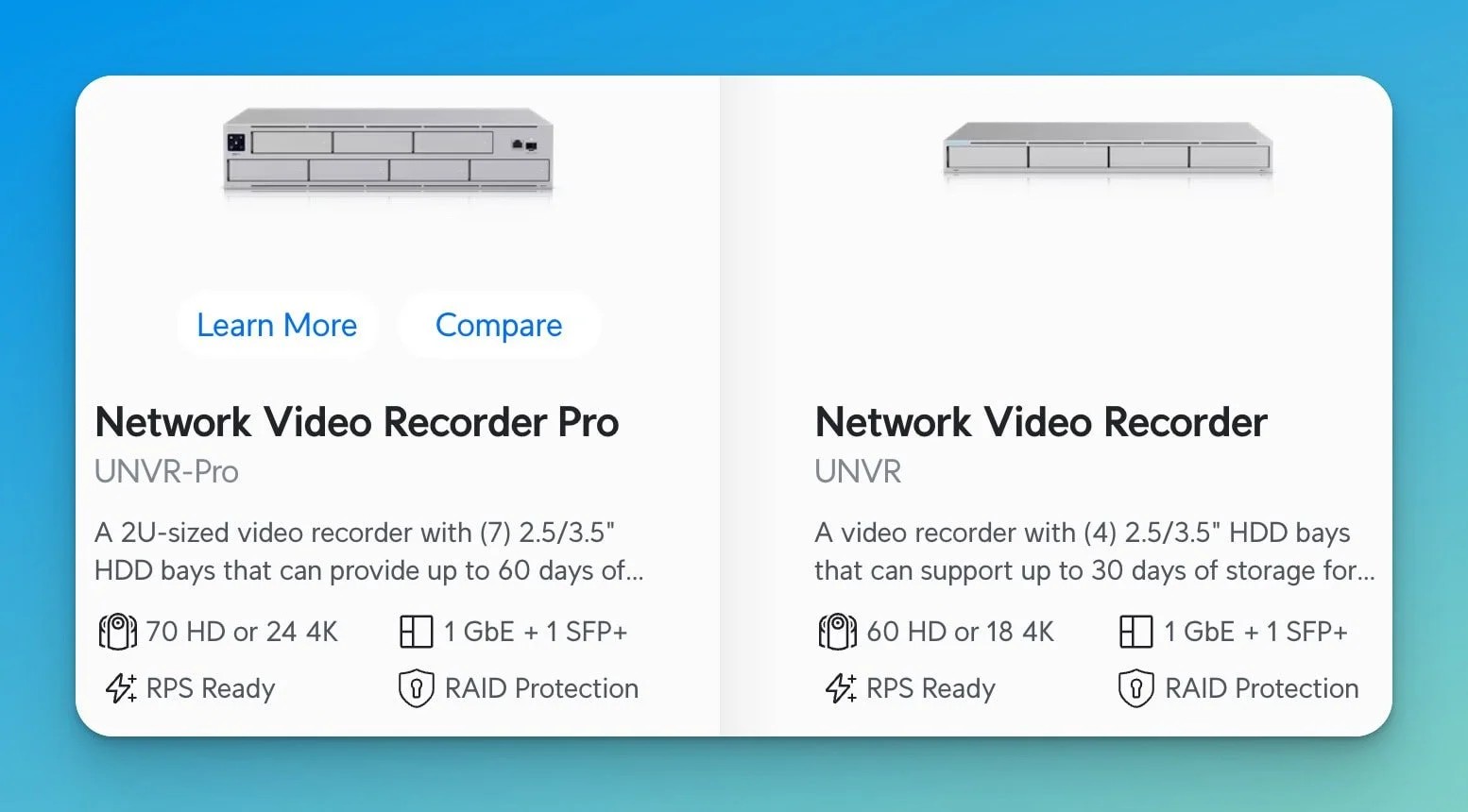
The UNVR and UNVR Pro both provide solid network video recording with UniFi Protect's no-licensing-fee model and support for third-party ONVIF cameras alongside native UniFi cameras (with some limitations — see ONVIF section below). The difference is scale: the UNVR is a 1U rackmount with four drive bays and 18 4K camera capacity, while the UNVR Pro is a 2U unit with seven drive bays and 24 4K camera capacity. Both support RAID 5 and RAID 10. In small-office and warehouse deployments, the main issue we see is not initial camera count, but retention and growth planning — choosing based on your 18-month trajectory avoids more migration work later. If you are starting from scratch with surveillance, our UniFi Protect CCTV guide covers the full system planning process.
What's New in 2026: The UNVR Gen 2 Lineup
Should you buy the UNVR G2 in 2026? For most new deployments, yes. The UNVR G2 has higher camera capacity, built-in AI analytics, HDMI output, and faster networking than the original UNVR. Ubiquiti launched both Gen 2 models in May 2026.
The original UNVR (Gen 1) is older hardware that now sits below the G2 in Ubiquiti's current NVR lineup. It is still listed in the Ubiquiti Store at $299 as of June 2026, but new deployments should compare it carefully against the G2 models. The original UNVR Pro ($499) is also still sold, but new deployments should weigh it against the G2 Pro given the notable feature differences.
| Model | Generation | Bays | 4K Camera Capacity | AI Analytics | HDMI ViewPort | Price |
|---|---|---|---|---|---|---|
| UNVR | Gen 1 | 4 | 18 | No | No | $299 |
| UNVR Pro | Gen 1 | 7 | 24 | No | No | $499 |
| UNVR G2 | Gen 2 (current) | 4 | 30 | Built-in | Yes | $699 |
| UNVR G2 Pro | Gen 2 (current) | 8 | 50 | Built-in | Yes | $999 |
The Gen 2 differences worth knowing before you buy:
Higher camera capacity. The UNVR G2 handles up to 30 recommended 4K cameras on four bays — 67% more than the original UNVR. The UNVR G2 Pro supports 50 4K cameras on 8 bays, more than double the original UNVR Pro's 24-camera capacity.
Built-in AI event analytics. The UNVR G2 family adds built-in Edge AI processing for newer Protect features such as faster forensic search and re-identification. Exact AI feature availability — including face recognition, license plate recognition, and package detection — depends on camera model, Protect version, and whether AI Key or AI Port is required for a specific deployment. Gen 1 units do not include Edge AI hardware.
HDMI ViewPort included. Both G2 models include an HDMI output for direct monitor display of camera feeds — no separate ViewPort device needed. One trade-off: when the HDMI port is actively in use as a live viewport, camera capacity on the UNVR G2 drops to 20 4K cameras (40 2K / 60 HD). If you need the full 30 4K camera limit, leave the HDMI port for occasional use or connect a monitor only when needed.
Upgraded networking. The G2 family ships with a 10G SFP+ port and a 2.5G RJ45 as standard — useful if you're pushing high-bitrate 4K streams across your network infrastructure.
Qualcomm Kryo CPU (UNVR G2). The G2 replaces the Gen 1's quad-core ARM Cortex A57 (1.7GHz, 4GB RAM) with a Qualcomm Kryo featuring one prime core at 3.2GHz, four performance cores at 2.8GHz, and three efficiency cores at 2GHz. The compute headroom is noticeably better.
The rest of this comparison covers both generations in detail — the Gen 1 models for those managing existing systems or sourcing secondary-market hardware, and the Gen 2 lineup for new builds.
When Gen 1 Still Makes Sense
Consider a Gen 1 UNVR or UNVR Pro only for budget-conscious existing deployments, replacement units for a system already running Gen 1 hardware, or stable camera counts where AI analytics and HDMI ViewPort are not priorities. For any new deployment where budget allows, the G2 models are the better starting point.
UNVR vs UNVR Pro Specs: What are the differences?
The main difference between the UNVR and UNVR Pro is scale. The UNVR ($299) supports 18 4K cameras and 4 drive bays. The UNVR Pro ($499) supports 24 4K cameras and 7 drive bays. Both support RAID 1, 5, and 10 — RAID 10 requires an even number of at least four drives on any UniFi NVR.
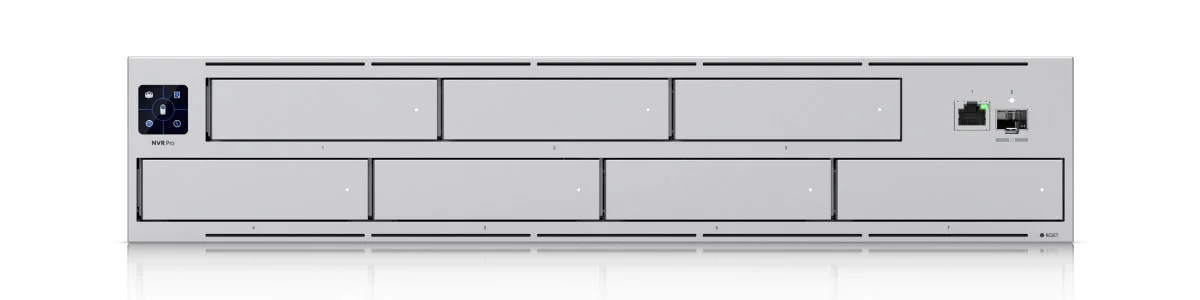
| Specs | ||
|---|---|---|
| Price | $299 | $499 |
| Form Factor | 1U Rackmount | 2U Rackmount |
| Drive Bays | 4 (2.5"/3.5") | 7 (2.5"/3.5") |
| Max Raw Storage | ~96TB (4x 24TB) | ~168TB (7x 24TB) |
| Camera Capacity (4K) | 18 | 24 |
| Camera Capacity (HD) | 60 | 70 |
| RAID Support | RAID 1, 5, 10 | RAID 1, 5, 10 |
| Stacking Support | Yes (Max 2 units) | Yes (Max 2 units) |
| Networking | 1x 10G SFP+, 1x GbE | 1x 10G SFP+, 1x GbE |
| Touchscreen Display | No | Yes (1.3") |
| Power Redundancy | Yes | Yes (USP-RPS compatible) |
Note: Storage capacity is determined by the drives you install, not the NVR itself. Ubiquiti lists official 8TB, 16TB, and 24TB UniFi HDDs and requires CMR 7200RPM drives. Third-party 22TB and 24TB surveillance drives are widely used. These are Gen 1 specifications; for Gen 2 specs see the UNVR G2 and G2 Pro.
What is the maximum storage capacity for UniFi NVRs?
Storage capacity on the UNVR and UNVR Pro is determined by the largest compatible SATA hard drives you install. Ubiquiti requires 1TB or larger CMR drives with 7200RPM read/write speeds and lists official 8TB, 16TB, and 24TB UniFi HDDs. As of June 2026, third-party 22TB and 24TB surveillance drives from WD and Seagate are widely used.
Previous documentation listing "32TB" or "56TB" limits was based on older 8TB drive standards. In 2026, you can install 22TB or 24TB surveillance drives (like the WD Purple Pro or Seagate SkyHawk AI) to achieve considerably more retention:
- UNVR (4 Bays): Up to ~96TB raw storage (4x 24TB drives)
- UNVR Pro (7 Bays): Up to ~168TB raw storage (7x 24TB drives)
Ubiquiti lists official 8TB, 16TB, and 24TB UniFi HDDs. The figures above assume 24TB drives, which are the largest officially listed capacity.
For extended retention (60-90+ days) with 4K cameras, the UNVR Pro's 7 bays are important for maintaining RAID 5 or RAID 10 protection without sacrificing too much usable space. For a detailed walkthrough of calculating your specific storage needs, see our UniFi Protect storage planning guide. If you are deciding between dedicated NVR hardware and a UNAS (UniFi network-attached storage) solution, our UNAS vs UNVR comparison covers the tradeoffs, and the UNAS Pro 4 review has hands-on details.
Drive Recommendation
Always use CMR surveillance-grade drives such as the WD Purple Pro or Seagate SkyHawk AI. These are designed for 24/7 continuous write workloads. Avoid SMR drives — Ubiquiti recommends CMR drives, and surveillance NVRs need sustained sequential write performance that SMR technology is not designed to deliver. High-capacity 24TB-class drives draw more power and produce more heat than smaller drives, so rack ventilation and drive health monitoring are important — especially in the UNVR Pro with 7 large drives.
Camera Capacity: When Six More Cameras Matter
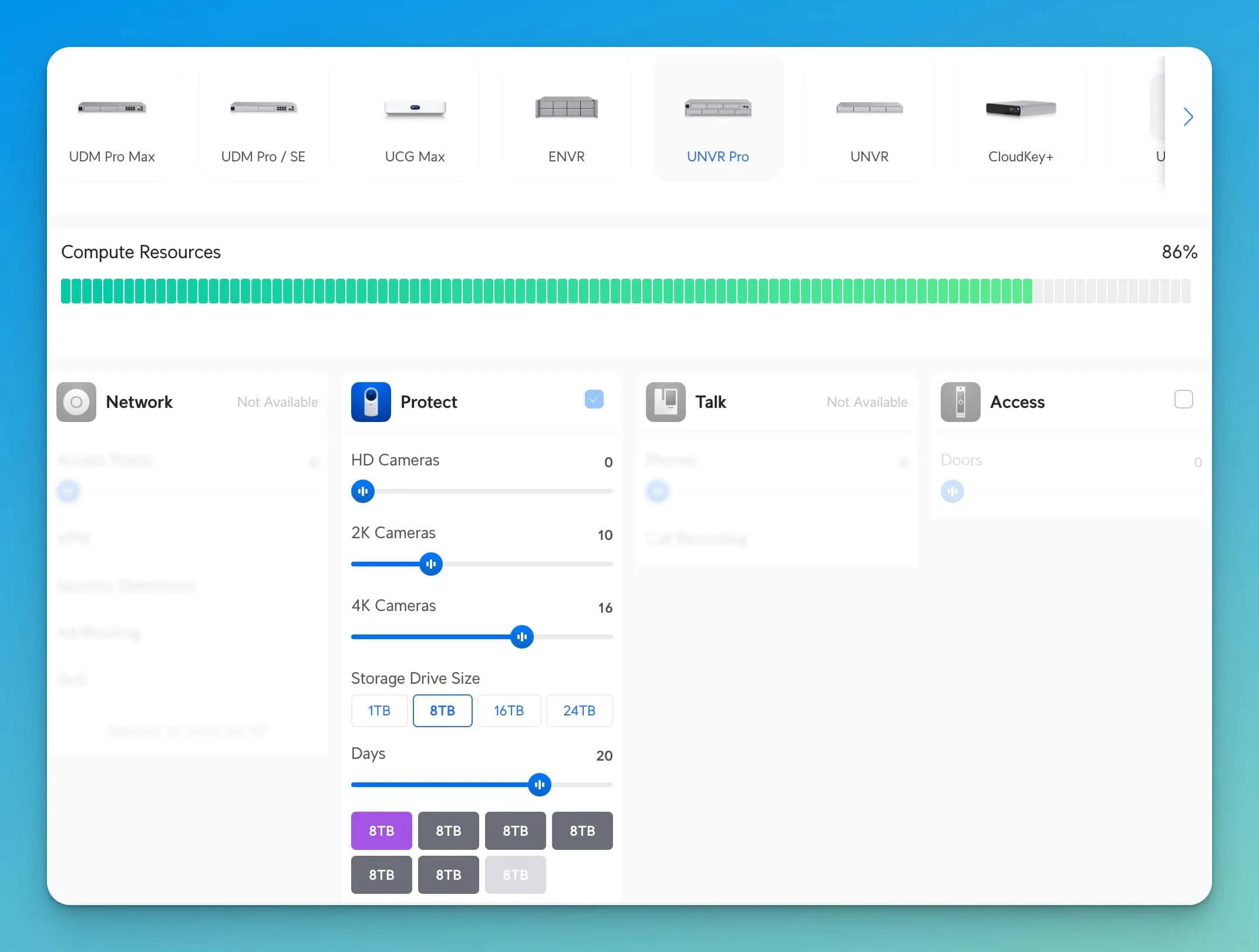
The UNVR handles up to 18 recommended 4K cameras, while the UNVR Pro supports 24. These are recommended capacity limits, not strict hard caps — Protect will warn you when a console exceeds its recommended load, and performance can decline depending on resolution, bitrate, detections, and live-view usage. For most small offices under 5,000 square feet, the UNVR's 18-camera capacity provides comfortable headroom.
A typical small office requires 8-12 cameras for comprehensive coverage of entry points, common areas, and sensitive zones. Planning for 125-150% of your initial camera count helps accommodate future additions without reaching the limit.
The UNVR Pro's higher capacity becomes relevant for multi-building deployments, larger retail spaces, or warehouse environments. A 15,000-square-foot distribution center might start with 16-18 cameras and grow to 22-24 as the business identifies additional coverage needs. If you are still choosing cameras for your deployment, our UniFi G6 camera buying guide covers the full lineup.
Stacking two NVRs is technically supported (two UNVRs or two UNVR Pros), but Ubiquiti strongly discourages it and recommends an ENVR or Vantage Point when more capacity is needed. Stacking carries notable limitations — see the dedicated section below.
Growth Planning Tip
Existing Gen 1 deployments: If you are starting with 10 cameras and expect to reach 14-15 within 18 months, the UNVR is a reasonable fit. If your current 12-camera deployment is phase one of a planned 20-camera system, the UNVR Pro can avoid a later migration. For 30+ cameras, step up to the Enterprise NVR (ENVR) rather than relying on stacking.
New builds: The UNVR G2 ($699) starts at 30 4K capacity — enough headroom that scaling decisions are less immediate. The UNVR G2 Pro's 50-camera ceiling covers most growing business deployments without requiring a step-up to the ENVR tier.
Storage Capacity and RAID Configuration
Both the UNVR and UNVR Pro support RAID 5 and RAID 10. RAID 10 requires an even number of at least four drives on any UniFi NVR or UNAS. With an odd number of drives, the last drive becomes a hot spare. The UNVR Pro's extra three drive bays provide practical advantages in raw capacity and RAID 10 usable space.
UNVR (4 bays): With four 18TB drives in RAID 5, you get approximately 54TB of usable space — enough for 60-80 days of retention with a 12-camera 4K system recording at medium bitrate. In RAID 10, the same four drives provide ~36TB usable with faster read/write performance.
UNVR Pro (7 bays): With seven 18TB drives in RAID 5, usable capacity reaches approximately 108TB. In RAID 10, six of the seven drives form mirrored pairs (~54TB usable) and the seventh becomes a hot spare — providing both faster read/write performance and automatic failover protection.
Retention Estimates
Retention depends on resolution, bitrate, frame rate, and motion vs. continuous recording. As a rough guideline with 4K cameras at 15 fps (~40-60 GB/day per camera):
- ~54TB usable (UNVR, RAID 5, 4x 18TB): ~60-80 days for a 12-camera system
- ~36TB usable (UNVR, RAID 10, 4x 18TB): ~40-55 days with faster playback performance
- ~108TB usable (UNVR Pro, RAID 5, 7x 18TB): ~120-150 days for a 12-camera system
- ~54TB usable (UNVR Pro, RAID 10, 7x 18TB): ~60-80 days with faster playback and a hot spare
For surveillance setups that require both long retention and fast playback, RAID 10 across the UNVR Pro's seven bays provides a good balance of speed, capacity, and automatic failover. For capacity-focused deployments where maximum retention matters most, RAID 5 is the practical choice on either model.
Should you buy the UNVR Pro for future proofing?
The UNVR Pro is the better choice if you need long-term retention (60+ days) or want more RAID 10 capacity across seven bays. Both models support RAID 10, but the Pro's extra bays give you considerably more usable space in that configuration.
- Buy the UNVR Pro if: You need storage density (24 cameras in 2U), higher RAID 10 capacity for long-retention high-bitrate playback, or 60-90 day retention with RAID protection.
- Buy the standard UNVR if: You have fewer than 15 cameras now and 30-day retention is sufficient. The UNVR's four bays support RAID 10 but with less usable capacity than the Pro.
Pro Tip: 50+ Cameras
For deployments exceeding 50 cameras, the Enterprise NVR (ENVR) ($1,999) is worth considering. It handles up to 70 4K cameras and 16 drive bays in a single unit.
Stacking vs Vantage Point: Scaling Beyond One NVR
Is UNVR stacking a good idea? Stacking is supported, but it should not be the default growth plan. Ubiquiti strongly discourages stacking UNVRs and recommends an ENVR or Vantage Point when more capacity or power is needed.
Stacking combines two UNVRs (or two UNVR Pros) under a single management interface. The parent console manages both units and balances new cameras automatically. However, the limitations are notable:
- Face Recognition and License Plate Recognition only run on the parent console
- Vantage Point is not supported with stacked consoles
- Global Alarm Manager is not supported with stacked consoles
- AI Key and AI Port only work with cameras on the parent console
- Camera sensor and access hub pairing is limited to the parent console
- You cannot access the child NVR directly — if the parent console fails, you lose access to the child
- Moving a camera between the parent and child erases all prior recordings for that camera
Vantage Point is a UniFi Protect feature for viewing and managing cameras from multiple independent NVRs on a single screen. It is the better option for multi-building or multi-site deployments where you want centralized monitoring without the limitations of stacking. Each NVR operates independently, so a failure on one unit does not affect the others.
When to Use Each
Stacking: Only when the limitations above are acceptable and you need a second NVR at the same site with unified camera management. Treat it as a supported fallback, not the preferred growth path.
Vantage Point: For multi-site or multi-building monitoring with separate NVRs. Each NVR remains independent and fully functional.
ENVR / ENVR Core: For deployments that need 50+ cameras or substantial storage density in a single unit. This is Ubiquiti's recommended path when a single UNVR or UNVR Pro is no longer sufficient.
Total Cost of Ownership Analysis
The $200 price difference between models represents only part of the total investment. The examples below use 18TB surveillance drives to illustrate the full cost picture. Market reporting in early 2026 showed sharp HDD price increases across several popular drive models, so verify current drive pricing before purchasing.
UNVR Complete System Cost (Example)
Base Configuration (12 cameras, 60-day retention with RAID 5, using 18TB drives):
| Item | Estimated Cost |
|---|---|
| UNVR | $299 |
| Four 18TB surveillance CMR drives (e.g., WD Purple Pro) | $1,200–$2,000 |
| Estimated Total | $1,499–$2,299 |
UNVR Pro Complete System Cost (Example)
Base Configuration (12 cameras, 120-day retention with RAID 5, using five 18TB drives):
With five 18TB drives in RAID 5, usable capacity is approximately 72TB. At an estimated 50GB per 4K camera per day (12 cameras = ~600GB/day), that yields roughly 120 days of retention.
| Item | Estimated Cost |
|---|---|
| UNVR Pro | $499 |
| Five 18TB surveillance CMR drives (e.g., WD Purple Pro) | $1,500–$2,500 |
| Estimated Total | $1,999–$2,999 |
The difference: the Pro unit plus one extra drive gives you roughly double the retention of the UNVR configuration, with room for two additional drives as your needs grow. Use current 18TB/20TB/24TB surveillance or enterprise CMR drives for the best value at time of purchase.
Migration Cost Consideration
If you start with the standard UNVR and later outgrow it, your options are migrating to the UNVR Pro ($1,999–$2,999 for unit + drives, plus professional installation labor) or stepping up to an ENVR. Stacking is technically possible but Ubiquiti discourages it due to notable feature limitations. If growth beyond 18 cameras is likely, selecting the Pro initially is the more cost-effective path.
Note: All drive costs and retention estimates are approximate and provided as illustrative examples using 18TB drives. Actual retention depends on resolution, frame rate, motion activity, compression, and drive performance. HDD prices have been volatile since late 2025 — verify current pricing for your preferred capacity before purchasing. Prices and availability checked against the Ubiquiti US Store on June 23, 2026. Availability may vary by region.
Real-World Deployment Scenarios
Three deployment patterns from our client base illustrate how different business situations point toward one model or the other.
Scenario 1: Growing Retail Chain
Business Profile:
- Current: 3 locations with 6 cameras each (18 total)
- Growth plan: Opening 2 additional locations annually
- Retention requirement: 45 days for loss prevention review
Recommendation: One NVR per location, with Vantage Point for central monitoring
With separate retail locations, each site should have its own properly sized NVR rather than consolidating all cameras into a single unit. A UNVR G2 at each location handles up to 30 4K cameras with room to grow, and 45-day retention is comfortable on four bays with 18TB+ drives. For existing Gen 1 sites, the UNVR Pro also works well at this camera count. Vantage Point ties up to five NVRs together into a single monitoring interface, so the loss prevention team can view all locations from one screen. Only consider an ENVR if a single location or campus will exceed 30-50 cameras on its own.
Scenario 2: Established Small Office
Business Profile:
- Single location: 4,000 square foot office
- Current deployment: 12 cameras covering entry points, common areas, and server room
- No expansion plans; stable business in leased space
- Retention requirement: 30 days for incident review
Recommendation: UNVR
The deployment is stable with no growth expected. The UNVR provides adequate capacity with comfortable headroom (12 of 18 cameras used). The $200 savings can fund higher-capacity drives for extended retention. If you are building a complete system from scratch, our guide to a UniFi Protect AI security system under $2,000 includes a full parts list and setup walkthrough.
Scenario 3: Multi-Building Campus
Business Profile:
- Current: 18 cameras across three connected buildings
- Growth plan: Campus expansion to five buildings (estimated 25 cameras)
- Retention requirement: 90 days due to insurance policy terms
- Priority: Construction site security and liability documentation
Recommendation: UNVR G2 Pro or ENVR
The planned 25-camera count exceeds the Gen 1 UNVR Pro's recommended 24-camera capacity, and 90-day retention at high-bitrate 4K requires substantial usable storage that RAID 10 on a 7-bay unit may not comfortably deliver. For a new build, the UNVR G2 Pro ($999, 50 4K cameras, 8 bays) is the cleaner fit — it provides headroom for both camera growth and retention. If the campus may expand further, the ENVR ($1,999, 70 4K cameras, 16 bays) is the safer long-term choice. With Vantage Point, cameras across all buildings can be monitored from a single dashboard regardless of which model you choose.
Migration Considerations
Understanding what migration from UNVR to UNVR Pro involves helps inform the initial purchase decision. The process requires technical work but is not exceptionally complex — the challenge lies in business disruption and handling historical footage.
The migration process involves:
- Installing the new UNVR Pro and configuring storage/RAID settings
- Adopting cameras to the new NVR (2-3 minutes per camera)
- A 15-camera system requires 30-45 minutes of hands-on work plus system initialization time
Historical footage challenges:
- UniFi Protect does not provide a native migration path for historical recordings
- Options include keeping the old UNVR powered on for historical review, manually exporting important footage, or accepting loss of non-archived footage
Migration costs:
- Professional migration typically takes 2–4 hours, depending on camera count, VLAN design, rack access, and whether historical footage needs to be exported. Labor rates vary by provider.
- New hardware + drives: $2,000-3,000+ (verify current drive pricing)
If your initial budget accommodates the Pro model, choosing it first saves this entire migration cost. Stacking a second UNVR is technically possible and avoids migration, but Ubiquiti discourages it due to notable feature limitations (see the Stacking vs Vantage Point section above).
Frequently Asked Questions
Should I buy the UNVR G2 instead of the original UNVR in 2026?
For a new deployment, yes. The original UNVR is older hardware that now sits below the G2 in Ubiquiti's current NVR lineup. The UNVR G2 ($699) supports 30 4K cameras versus 18 on the original, adds built-in AI analytics, an HDMI ViewPort, a faster Qualcomm Kryo processor, and standard 10G SFP+ networking. The price is higher ($699 vs $299), but the Gen 2 hardware is the appropriate choice for a new install.
Is the extra $200 worth it for the UNVR Pro?
The UNVR Pro is worth the extra $200 if you need long-term retention (60+ days), more RAID 10 capacity across seven bays, or plan to exceed 18 4K cameras. Both models support RAID 10, but the Pro's extra bays give you considerably more usable space. For stable deployments with fewer than 15 cameras and 30-day retention, the standard UNVR offers better value. Note: for new builds, compare the UNVR G2 ($699) vs UNVR G2 Pro ($999) instead.
What happens when I hit the camera limit?
Ubiquiti's published camera counts are recommended capacity limits, not strict hard caps. Protect will warn you when a console exceeds its recommended load, and performance can decline depending on resolution, bitrate, detections, and live-view usage. If you need more capacity, your best options are upgrading to the UNVR Pro or the Enterprise NVR (ENVR), or reducing camera resolution and bitrate. Stacking a second NVR is technically supported (up to 2 units) but Ubiquiti discourages it due to notable feature limitations — see the Stacking vs Vantage Point section above.
What hard drives should I use in a UniFi NVR?
Use CMR surveillance-grade drives such as the WD Purple Pro or Seagate SkyHawk AI. These are designed for 24/7 continuous write workloads and are available in 18TB, 20TB, 22TB, and 24TB capacities. Avoid SMR drives — Ubiquiti recommends CMR, and surveillance NVRs need sustained write performance that SMR technology is not designed to deliver.
What is UniFi Vantage Point?
Vantage Point is a UniFi Protect feature that lets you view and manage cameras from multiple NVRs on a single screen. It is ideal for multi-building or multi-site deployments where you want centralized monitoring without consolidating all cameras onto one NVR.
Can I stack two UNVRs together?
Yes, but Ubiquiti strongly discourages it. Stacking supports two UNVRs or two UNVR Pros under a single management interface, combining camera capacity. However, AI features (Face Recognition, LPR) only run on the parent console, Vantage Point is not supported with stacked consoles, and you cannot access the child NVR directly — if the parent fails, you lose access to the child. For most scaling needs, Ubiquiti recommends an ENVR or separate NVRs with Vantage Point instead.
What are the limitations of UniFi NVR stacking?
Ubiquiti strongly discourages stacking and lists notable limitations. See the full list in the Stacking vs Vantage Point section above. The key ones: AI features are parent-only, Vantage Point is incompatible with stacked consoles, and you lose access to the child if the parent fails.
Which model is more reliable?
Both models use similar enterprise-grade components with comparable reliability. The UNVR Pro includes a touchscreen display for quick status checks and supports redundant power supplies (USP-RPS compatible), but these affect convenience rather than fundamental reliability. Both exhibit similar uptime in our deployments. For long-term reliability data across UniFi hardware, see our 4-year fleet reliability report.
Can I mix different drive sizes in the same NVR?
Yes, but RAID configurations limit usable capacity to the smallest drive in the array. For optimal utilization, use identical capacity drives. If mixing sizes, place smaller drives in positions you plan to upgrade first.
How much rack space do I need?
The UNVR requires 1U (1.75 inches), while the UNVR Pro requires 2U (3.5 inches). Both use standard 19-inch rack width. Do not let a single rack unit difference drive your decision if the Pro better fits your deployment needs.
Alternative Considerations
Five other UniFi NVR products are worth considering for deployments that fall outside the standard UNVR vs UNVR Pro comparison:
UNVR G2 ($699) and UNVR G2 Pro ($999): The current-generation NVRs for new builds. The G2 covers 30 4K cameras with built-in Edge AI; the G2 Pro handles 50 4K cameras across 8 bays. Both include HDMI ViewPort. See the "What's New in 2026" section above for a full breakdown.
UNVR Instant ($199 standalone, diskless): Suitable for small deployments with 6 or fewer 4K cameras. Includes an integrated 6-port PoE switch, HDMI ViewPort, and a desktop form factor — useful for small offices without rack infrastructure. Ubiquiti also sells a $699 UNVR Instant Kit that bundles four G5 Turret Ultra cameras and a 1TB drive. See our UNVR Instant review for a detailed look.
Enterprise NVR (ENVR) ($1,999): The standard enterprise tier for large-scale deployments. Supports up to 70 4K cameras with 16 drive bays and redundant power supplies. This is the right choice for deployments exceeding 50 cameras where stacking two NVRs is not sufficient.
Enterprise NVR Core (ENVR Core): A high-capacity model Ubiquiti introduced alongside the G2 refresh. The ENVR Core offers 16 bays with optional 16-bay expansion units and supports up to 300 4K cameras — intended for large campus or multi-building deployments where even the standard ENVR's 70-camera limit is a constraint. Verify pricing and availability at the Ubiquiti store.
If you are evaluating other platforms alongside UniFi, our UniFi Protect vs Synology Surveillance Station comparison covers the key trade-offs.
Third-Party ONVIF Camera Support
All UniFi NVRs support third-party ONVIF cameras alongside native UniFi cameras. Live view and playback work reliably. Motion detection, PTZ control, and audio are listed as supported, but compatibility depends on the specific camera model and its ONVIF implementation. Advanced UniFi Protect features — including AI detections (face recognition, license plate recognition, package detection) and smart event analytics — are not available on third-party cameras. For business deployments where AI detections, long-term supportability, and integration simplicity matter, native UniFi cameras remain the cleaner option.
Making Your Decision
Our Recommendation
New deployment in 2026? Start with the UNVR G2 ($699) for up to 30 4K cameras with built-in Edge AI, or the UNVR G2 Pro ($999) for 50 4K camera capacity across 8 bays. The Gen 1 UNVR is older hardware; new installs should start with the G2.
Managing existing Gen 1 hardware? The UNVR ($299) suits stable deployments with fewer than 15 cameras. The UNVR Pro ($499) is the better pick for 15+ cameras, 60-90 day retention, or higher RAID 10 capacity across seven bays.
Large-scale deployments (50+ cameras): Choose the ENVR ($1,999) or the ENVR Core for the highest capacity and drive density in the UniFi lineup.
For businesses in Miami needing professional guidance on UniFi Protect deployments, contact our team for a consultation. We have deployed both UNVR and UNVR Pro systems across various business environments and can help you determine which model fits your specific requirements and budget.
Affiliate Disclosure: This article contains affiliate links. If you make a purchase through these links, we may earn a small commission at no extra cost to you. As an Amazon Associate, iFeelTech earns from qualifying purchases.
Related Articles
More from UniFi Networks
UniFi Dream Machine Pro Max Capacity Planning: When to Add a Standalone NVR
Learn when to separate your UniFi Protect cameras to a standalone NVR. Covers compute resource allocation, CyberSecure impact, AI camera requirements, and NVR options from UNVR Instant to Enterprise.
18 min read

UniFi Protect vs. Reolink vs. TP-Link: Which Camera System Is Best for Your Business?
UniFi Protect, Reolink, and TP-Link (Tapo vs. VIGI) compared for small business use — current 2026 lineups, real 8-camera pricing, and iFeelTech's multi-year UniFi fleet reliability data.
19 min read

We Ran 538 Ubiquiti Devices for 4 Years. Here's What Actually Failed.
Real fleet data: 538 UniFi devices tracked over 4 years. 0.74% replacement rate, 99.99% core uptime, and five incident post-mortems from commercial sites.
15 min read