
Windows 11 Home vs Pro for Business (2026): What You Actually Need
Business-focused Windows 11 Home vs Pro comparison. Discover which edition you need based on remote work, encryption, and team management requirements, with clear buying guidance for small businesses.

Quick Answer
Windows 11 Home ($139) is best for personal use, gamers, and freelancers with no compliance needs.
Windows 11 Pro ($199) is required for businesses that need BitLocker encryption (for HIPAA/GDPR), Remote Desktop hosting, or Domain Join.
Buying Advice: If you plan to join a company network or manage more than 3 devices, buy Pro upfront to save $39 compared to upgrading later.
Note: Home edition includes basic Device Encryption (not full BitLocker).
With Windows 10 Extended Security Updates expiring October 2026, now is the right time to choose the correct edition for your next device.
Windows 11 Home vs Pro: Business Decision Guide

Choose your Windows 11 edition based on your specific business needs:
| Business Need | Required Feature | Home | Pro | Why Pro Matters |
|---|---|---|---|---|
| Remote access to office PC | Remote Desktop (host) | ❌ | ✅ | Built-in secure access for remote work |
| HIPAA/PCI-DSS/GDPR compliance | BitLocker + audit controls | Device Encryption only | Full BitLocker | Required for regulatory compliance (fines start at $100-$50k) |
| Managing 3+ employee devices | Group Policy + Domain Join | ❌ | ✅ | Centralized security and consistent configs |
| IT provisioning without cloud | OOBE offline setup | ❌ | ✅ | Deploy without forced Microsoft Account |
| Zero-touch laptop deployment | Windows Autopilot | ❌ | ✅ | Ship laptops direct to employees, auto-configure |
| Software development/testing | Hyper-V virtualization | ❌ | ✅ | Test environments without separate hardware |
| Solo freelancer (no compliance) | Standard features | ✅ | Optional | Home sufficient; save $60 upfront |
| Laptop data protection | BitLocker encryption | Device Encryption | Full BitLocker | Protection if device stolen or lost |
| Untrusted software testing | Windows Sandbox | ❌ | ✅ | Isolated environment that resets after use |
| Public-facing terminals | Kiosk Mode | ❌ | ✅ | Lock devices to single application |
| Maximum RAM support | Hardware capacity | 128 GB | 2 TB | Pro for workstation-class machines only |
Quick Decision Rule
Choose Windows 11 Pro if your business:
- Has 3 or more employees (or plans to hire soon)
- Handles customer payment information, medical records, or regulated data
- Requires compliance with HIPAA, PCI-DSS, GDPR, or SOC 2
- Needs employees to access office computers remotely
- Uses Microsoft Autopilot for device provisioning
- Requires local administrator accounts without Microsoft Account dependency
Pricing: Windows 11 Pro costs $199 vs Home at $139 ($60 difference)
Windows 11 Home and Pro Pricing Comparison
Windows 11 Home costs $139, while Windows 11 Pro costs $199. Upgrading from Home to Pro later costs $99, resulting in a $39 total premium.
Official Pricing Structure
- Windows 11 Home: $139 (new license)
- Windows 11 Pro: $199 (new license) – Available on Amazon for ~$150 (OEM/System Builder)
- Home to Pro Upgrade: $99 – Available on Amazon
Cost Consideration
If you start with Home and later upgrade to Pro, you'll pay $238 total ($139 + $99), which is $39 more than buying Pro initially. This makes starting with Pro the more cost-effective choice if you anticipate needing Pro features within the first year.
What the $60 Price Difference Covers
The Pro edition adds capabilities that primarily benefit business operations, development work, and advanced security requirements. The investment represents approximately 2.5 hours of billable work at $25/hour. For businesses, Pro's efficiency gains typically recover this cost within the first year through improved productivity and reduced security incidents.
Educational and Volume Licensing Options
Students and Educators: Many educational institutions provide free or discounted Windows licenses through academic programs like Microsoft Azure Dev Tools for Teaching or institutional volume licensing agreements. Check with your school's IT department before purchasing a retail license.
Businesses: Organizations purchasing multiple licenses should explore Microsoft's volume licensing programs, which offer per-unit discounts and simplified license management for fleets of 5 or more devices.
SMB Decision Matrix: Which Edition for Your Business Profile?
The feature table above shows what each edition includes. This matrix answers which businesses actually need Pro — based on real deployment scenarios.
| Business Profile | Verdict | Key Reason |
|---|---|---|
| Solo freelancer, no regulated data | Home | No compliance need; save $60 |
| Freelancer handling client PHI or financials | Pro | BitLocker required for HIPAA/PCI-DSS |
| 2–4 person team, cloud-only (Google Workspace / M365) | Pro | Remote Desktop + device management worth the $60 |
| 5–20 person team with on-premises server | Pro (required) | Active Directory domain join is Pro-exclusive |
| Remote-first team, no on-premises server | Pro | Group Policy + Autopilot for device provisioning |
| Developer or technical professional | Pro | Hyper-V + Windows Sandbox + Remote Desktop |
| Retail or kiosk deployment | Pro (required) | Assigned Access (Kiosk Mode) is Pro-exclusive |
| Copilot+ PC buyer, AI features are the priority | Home is fine | Copilot+ features are hardware-dependent, not edition-dependent |
| Microsoft 365 Business Premium subscriber | Pro included | M365 Business Premium includes Windows 11 Enterprise upgrade rights |
Managing 50+ employees or using Microsoft Copilot with company data? The decision shifts from Home vs Pro to Pro vs Enterprise. See our Windows 11 Pro vs Enterprise guide for subscription licensing options, Copilot data protection requirements, and the July 2026 M365 pricing changes.
Windows 365 Cloud PC: Alternative to Local Pro Licenses
Windows 365 Cloud PC allows businesses to access Windows 11 Enterprise features from any device through a browser-based virtual desktop. Instead of purchasing Pro laptops for every employee, businesses can buy Home devices and subscribe to Cloud PCs starting at $31/month per user.
Cost comparison: A $800 Home laptop + $41/month Cloud PC subscription provides the same Pro features as a $1,200 Pro laptop, with the added benefit of centralized management and access from any device.
Best for: Hybrid businesses, seasonal workers, or organizations wanting simplified IT management without on-premises servers. Windows 365 includes automatic updates and can be accessed from Home edition devices.
Not suitable for: Users requiring offline access to Pro features or businesses with unreliable internet connectivity.
What's New in Windows 11 (24H2 Update)
The Windows 11 24H2 update, released in late 2024, brought significant new features to both Home and Pro editions. Understanding these additions helps contextualize what you're getting with either version.
New Features in Both Editions
Connectivity and Hardware:
- Wi-Fi 7 support for faster wireless networking
- Bluetooth LE Audio with improved hearing aid compatibility
- HDR background support for dynamic desktop images
Productivity Improvements:
- File Explorer now creates 7z and TAR archives natively
- Text labels return to taskbar buttons (configurable)
- Sudo for Windows enables elevated commands from standard terminals (particularly useful for developers on Pro)
- Energy Saver mode works on both laptops and desktops
- Voice Clarity for AI-powered background noise removal in calls
Phone Link Enhancements:
- Improved Android device integration
- Use phone as webcam
- Better file access across devices
Sudo for Windows:
- Enables elevated commands from standard terminals
- Requires Developer Mode (available in both Home and Pro)
- Primarily benefits developers who should consider Pro for additional features
Copilot+ PC Features (Hardware Dependent)
Copilot+ PCs represent a new category of Windows devices with dedicated AI hardware. These features require a Neural Processing Unit (NPU) capable of 40+ TOPS and work on both Home and Pro editions:
- Recall (Preview): Search your computing history by describing what you were looking at
- Live Captions: Real-time transcription with translation from 44 languages to English
- Windows Studio Effects: Enhanced video call features including background blur, auto-framing, and eye contact correction
- Cocreator in Paint: Generate images from sketches and text prompts
- Click to Do: AI-powered screen analysis with suggested actions
Copilot+ Note
Copilot+ features are hardware-dependent, not edition-dependent. A Windows 11 Home laptop with an NPU will have access to these AI features, while a Pro laptop without the required hardware will not. When shopping for new hardware, look for "Copilot+ PC" branding—examples include the Microsoft Surface Laptop 7, Dell Inspiron 14 Copilot+, and Samsung Galaxy Book5 Pro.
Important: Windows 11 Pro does NOT give you better Copilot performance. AI performance is tied to the NPU (hardware), not the OS license. Both Home and Pro deliver identical AI capabilities on equivalent hardware.
Copilot Subscription Confusion
Clarification: Windows 11 (both Home and Pro) includes the free Windows Copilot assistant. However, this does NOT include:
- Copilot Pro ($20/month): Priority GPT-4 access, custom GPTs, enhanced image generation, and cross-app integration
- Copilot for Microsoft 365: Requires Microsoft 365 subscription; works in Word, Excel, PowerPoint, Outlook, and Teams
Buying Windows 11 Pro does not include these paid subscriptions. The free Copilot assistant in Windows 11 provides basic AI features, while paid subscriptions offer advanced capabilities across devices and applications.
Hardware vs. Subscription: Copilot+ PC features (Recall, Live Captions, Windows Studio Effects) depend on NPU hardware, not subscriptions. You can have a Copilot+ PC without Copilot Pro, or Copilot Pro without a Copilot+ PC.
Copilot+ PCs for Business: Procurement Guidance
The edition question is settled: Copilot+ features (Recall, Live Captions, Windows Studio Effects) work identically on Home and Pro. Buying Pro does not improve AI performance. Buy Pro for the management and security features, not for Copilot+.
The hardware question for SMBs:
- Buy Copilot+ if: Your team does video calls, transcription, or translation work — Live Captions with real-time translation from 44 languages is a genuine productivity feature for international teams.
- Hold off if: Your primary use case is document editing and email. The NPU adds cost ($100–$200 premium over equivalent non-Copilot+ hardware) without measurable benefit for standard office workflows.
- ARM caveat for IT teams: Copilot+ PCs on Snapdragon X Elite/Plus have Hyper-V limitations (single virtual processor, ARM guests only). If your IT workflow depends on running Windows VMs or x86 Linux, choose Intel/AMD Pro hardware instead.
Recall and privacy: As of March 2026, Recall is opt-in and stores snapshots locally on the device (not in the cloud). For businesses handling regulated data, verify your compliance posture before enabling Recall on devices that process PHI or financial records.
What Both Editions Include
Both Windows 11 Home and Pro share the same core experience (redesigned Start Menu, Snap Layouts, Virtual Desktops, Windows Security, Microsoft Defender, Windows Hello, OneDrive, DirectX 12 Ultimate) and identical hardware requirements. The differences lie exclusively in business management, security administration, and advanced IT features detailed below.
Windows 11 Pro: Exclusive Features Explained
Windows 11 Pro includes additional capabilities designed for business environments, IT management, and advanced security requirements.
1. BitLocker Drive Encryption
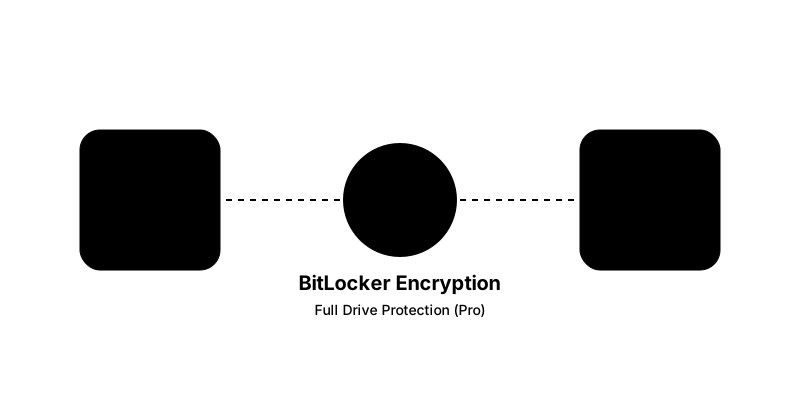
BitLocker is a Windows 11 Pro exclusive feature that encrypts your entire hard drive to protect sensitive data on lost or stolen devices.
Who Needs It:
- Mobile professionals: Laptop users who work from multiple locations
- Regulated industries: Healthcare, finance, legal, and other sectors with compliance requirements (HIPAA, PCI-DSS, GDPR)
- Businesses with sensitive data: Companies storing customer information, financial records, or proprietary data (see our business password manager guide)
- Remote workers: Employees working from home or public spaces
Windows Home (Device Encryption): Encrypts your data but ties the recovery key solely to your personal Microsoft Account. If you lose access to that account, you lose your data.
Windows Pro (BitLocker): Offers enterprise-grade management. IT can store recovery keys in Active Directory or Microsoft Entra ID (formerly Azure AD), rotate keys remotely, and ensure compliance with HIPAA/GDPR auditing standards. If an employee's drive becomes locked, IT can retrieve the recovery key remotely to unlock the drive.
BitLocker SMB Workflow: What IT Actually Does
For a 10-person business, BitLocker management involves three operational steps:
- Enable via Group Policy: Push a GPO that enforces BitLocker on all Pro devices at next login. Devices without TPM 2.0 will flag for hardware review.
- Escrow recovery keys to Entra ID: Configure the GPO to require key backup to Microsoft Entra ID (formerly Azure AD) before encryption completes. This means IT can retrieve any device's recovery key from the Entra admin portal — no spreadsheet of keys needed.
- Employee offboarding: When an employee leaves, disable their Entra account. Their BitLocker recovery key remains in Entra under IT control. If the device is returned, IT retrieves the key from the portal. If the device is lost, the data is unreadable without the key.
Compliance audit trail: Entra ID logs every key retrieval with timestamp and admin identity — this is the audit record HIPAA and PCI-DSS auditors look for.
Home edition gap: Device Encryption on Home ties the recovery key to the employee's personal Microsoft Account. When they leave, IT has no access to that key. If the device is returned locked, the data may be unrecoverable.
2. Remote Desktop (Host Capability)
Remote Desktop is a Pro-exclusive feature that allows you to access your computer from any device with an internet connection. Windows 11 Home can connect to other computers but cannot host incoming connections.
Who Needs It:
- Remote workers: Access office computers from home
- IT support teams: Provide remote assistance without third-party tools
- Multi-location businesses: Access specific computers at branch offices
- Development teams: Access powerful workstations from lightweight devices
Alternative for Home Users: Windows 11 Home can connect TO other computers via Remote Desktop but cannot host connections. Third-party tools like Chrome Remote Desktop (free, cross-platform), RustDesk (open-source, privacy-focused), TeamViewer, or AnyDesk provide similar functionality across both editions.
3. Domain Join and Active Directory
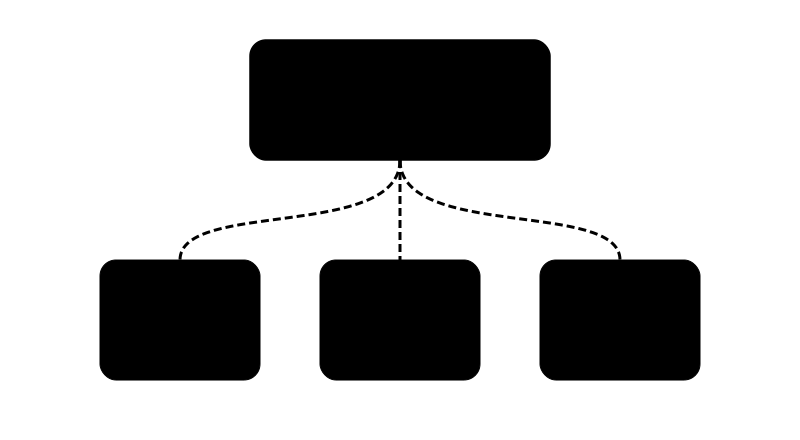
Windows 11 Pro can join Active Directory domains for centralized user management and single sign-on. Windows 11 Home cannot join traditional domains but supports Microsoft Entra ID (formerly Azure AD) with limited functionality.
Who Needs It:
- Established businesses: Organizations with existing Windows Server infrastructure
- IT-managed environments: Companies requiring centralized user authentication
- Compliance-driven organizations: Industries requiring audit trails and access controls
- Multi-site enterprises: Businesses with distributed locations needing unified management
Alternative for Home Users: Small businesses without Active Directory can use Microsoft Entra ID (formerly Azure AD) with Windows 11 Home, though with limited functionality compared to full domain join.
3a. Local Account Setup (Microsoft Account Requirement)
Critical difference: Windows 11 Home forces you to create or sign in with a Microsoft Account during setup—there is no official way to create a local offline account during installation. Windows 11 Pro allows local account creation without internet or cloud dependency.
Why this matters: Home edition requires internet connectivity and a Microsoft email address during Out-of-Box Experience (OOBE). Pro offers an "I don't have internet" path or "Domain Join" option, allowing IT teams to create local administrator accounts for pre-provisioning devices, maintaining air-gapped systems, or deploying to locations without reliable internet.
Who Needs This:
- IT departments: Provisioning multiple devices without cloud accounts
- Compliance environments: Organizations requiring local-only authentication
- Enterprise deployments: Pre-configuring devices before employee assignment -High-security environments:** Avoiding mandatory cloud account creation
4. Group Policy Management
Group Policy is a Pro-exclusive feature that allows IT administrators to configure and enforce settings across multiple computers from a central location, including security policies, software installation, and access restrictions.
Who Needs It:
- IT departments: Managing settings for multiple users and computers
- Businesses with compliance requirements: Enforcing security policies consistently
- Organizations with standardized configurations: Maintaining consistent desktop environments
- Companies with high security needs: Restricting access to system features and settings
Windows Autopilot Integration: Pro edition enables Windows Autopilot, Microsoft's zero-touch deployment service. Ship laptops directly from the manufacturer to employees; when powered on, devices automatically join your domain, install apps, and apply policies without IT touching the device. This saves hours of IT time per deployment and eliminates shipping costs to/from IT.
5. Hyper-V Virtualization
Hyper-V is a Pro-exclusive feature that creates virtual machines to run complete operating systems within Windows, enabling software testing and development without separate physical computers.
Who Needs It:
- Software developers: Testing applications across different OS versions
- IT professionals: Creating test environments without dedicated hardware
- Security researchers: Analyzing potentially dangerous software safely
- Businesses running legacy applications: Maintaining older software versions in isolated environments
Alternative for Home Users: Third-party virtualization tools like VirtualBox (free), VMware Workstation Player (free for personal use), or VMware Workstation Pro (paid) work on Windows 11 Home with similar functionality.
ARM/Snapdragon X Elite Hyper-V Limitations
Important for Copilot+ PC buyers: Windows 11 Pro on ARM-based processors (Snapdragon X Elite) includes Hyper-V but with significant limitations as of March 2026:
- Single virtual processor only: Enabling multiple virtual processors causes system hangs and long pauses
- ARM guest OSes only: Cannot run x86/x64 operating systems; limited to ARM-based Linux distributions
- Incomplete firmware support: Installation failures and compatibility issues with most Linux distributions
- Business impact: ARM-based Pro laptops do not provide equivalent Hyper-V functionality to Intel/AMD Pro machines
Recommendation: If Hyper-V virtualization is essential for your business, choose Intel or AMD processors. ARM-based Copilot+ PCs excel at AI features but have limited virtualization capabilities.
6. Windows Sandbox
Windows Sandbox is a Pro-exclusive feature that creates a temporary, isolated Windows environment for testing untrusted software. All changes are discarded when closed.
Who Needs It:
- Users downloading software from unknown sources
- Security-conscious individuals opening email attachments
- IT professionals quickly testing configuration changes
- Software testers verifying installation procedures
7. Assigned Access (Kiosk Mode)
Assigned Access is a Pro-exclusive feature that locks a computer to run only one application, preventing access to the Start menu, other apps, or system settings.
Who Needs It:
- Retail businesses: Point-of-sale terminals and customer-facing displays
- Hospitality industry: Check-in kiosks and information displays
- Public spaces: Library catalog systems or public information terminals
- Manufacturing: Production monitoring stations
8. Increased Hardware Capacity
Windows 11 Pro supports up to 2 TB of RAM and 2 physical CPUs, compared to Home's 128 GB RAM and 1 CPU limit. While most users won't approach these limits, workstation users running complex simulations, large-scale data analysis, or professional content creation may benefit from the additional capacity.
Real-World Use Cases and Recommendations
For Personal and Home Office Users
When Home Edition Is Sufficient
- General computing: Web browsing, email, document editing, media consumption
- Home office work: Independent contractors, freelancers without complex IT needs
- Students: Academic work, research, and personal projects
- Gaming: All gaming features are identical between Home and Pro
- Content creation: Photo and video editing for personal or small business use
Consider Pro If You
- Work remotely: Need to access your home computer from other locations
- Handle sensitive client data: Freelancers in healthcare, legal, or financial services need encryption
- Travel frequently with your laptop: BitLocker provides essential protection for mobile devices
- Work with virtual machines: Developers or tech enthusiasts who need local testing environments
For Gamers and Content Creators
Gaming Performance: Windows 11 Home and Pro deliver identical gaming performance. Both editions include DirectX 12 Ultimate, Auto HDR, and DirectStorage. There is no FPS (frames per second) advantage to buying Pro for gaming. Your GPU, CPU, and RAM determine gaming performance, not your Windows edition.
When gamers should consider Pro:
- Streaming and content creation requiring Hyper-V for testing
- Running game servers that need Remote Desktop access
- Development work (modding, game development) requiring virtualization
For pure gaming without development or server hosting needs, Home edition is sufficient and saves $60.
For Small Business Owners
Choose Pro If Your Business:
- Stores customer data requiring encryption
- Has compliance obligations (HIPAA, PCI-DSS, or other regulations)
- Operates with employees in multiple locations
- Uses company-owned devices needing consistent configurations
- Plans to grow beyond 5 employees
Our experience implementing small business network infrastructure consistently shows that businesses benefit from the Pro edition when they reach approximately 3-5 employees or when handling regulated data, regardless of size.
For Established Businesses and Enterprises
Pro Is Required For:
- Domain-joined networks with Active Directory integration
- Centralized IT management with Group Policy
- Security compliance programs requiring BitLocker encryption
- Standardized deployments with consistent management capabilities
- Remote support requirements using built-in Remote Desktop
Mixing Home and Pro editions within the same organization creates management complexity and security gaps. For businesses with professional IT oversight, standardizing on Pro edition across all devices simplifies administration and ensures consistent security policies.
For Developers and Technical Professionals
Pro Provides Important Capabilities:
- Hyper-V virtualization for testing across different operating systems
- Windows Sandbox for safely testing potentially problematic software
- Remote Desktop for accessing development machines from anywhere
- Domain join for connecting to corporate development environments
- Increased RAM support for running multiple VMs simultaneously
Windows 10 End of Support: What It Means Now
Support Status
October 14, 2025: Windows 10 mainstream support ended. With less than 7 months remaining until the Extended Security Update period expires (October 2026), systems no longer receive security patches for newly discovered vulnerabilities.
Extended Security Updates (ESU) Options:
For Consumers: Microsoft offers a one-time, one-year Extended Security Update for $30 that covers up to 10 PCs per Microsoft account. This temporary solution expires in October 2026. You can also access Year 1 free by syncing PC settings via Windows Backup to the cloud or redeeming 1,000 Microsoft Rewards points.
For Businesses: The ESU program runs for up to three years, but pricing escalates annually ($61 → $122 → $244 per device). Requires Windows 10 version 22H2 and enrollment through volume licensing.
ESU is not intended as a long-term solution for either consumer or business users.
If You're Still on Windows 10
For Personal Users:
- Evaluate hardware compatibility using Microsoft's PC Health Check tool (Windows 11 requires TPM 2.0 and 8th-gen Intel or 2nd-gen AMD Ryzen processors—see our Windows 11 system requirements guide)
- Choose the edition that meets your needs for the next 3-5 years
- Consider your encryption and remote access requirements when deciding between Home and Pro
- Budget for potential hardware upgrades if your current system doesn't meet requirements
For Businesses:
- Prioritize migrating remaining Windows 10 systems
- Standardize on Windows 11 Pro for centralized management and security
- Plan for hardware refresh cycles if devices don't meet Windows 11 requirements
- Consider current compliance requirements when selecting editions
With less than 7 months until the ESU program expires in October 2026, organizations still running Windows 10 should treat migration as an immediate priority given the security implications of running unsupported software.
Making Your Purchase Decision
Where to Buy
Direct from Microsoft:
- Guaranteed authentic licenses
- Full support access
- Easy digital delivery
- No ambiguity about terms
Authorized Retailers (Amazon, Newegg, Walmart):
- Competitive pricing (often $150-180 for Pro vs $199 MSRP)
- Same official licensing as Microsoft
- Retail licenses that transfer between compatible devices
- May offer bundled deals with hardware
For businesses, consider:
- Microsoft Volume Licensing: For 5+ licenses, volume programs offer cost savings and simplified management
- OEM Licenses: When purchasing new computers, OEM-installed Windows is typically less expensive than buying separate licenses
- Microsoft 365 Business Premium: Includes Windows 11 Enterprise upgrade rights along with productivity and security tools
- Need Enterprise? If your team uses Microsoft Copilot with company data or you have 50+ employees, see our Windows 11 Pro vs Enterprise guide — including the July 2026 M365 price increase timeline and how to lock in current rates.
Understanding License Types
Retail License ($199 for Pro):
- Transferable: Can move to a new computer if you upgrade hardware
- Purchased from Microsoft or authorized retailers
- Includes full Microsoft support
- Best for users who upgrade PCs every 3-5 years
OEM License (~$150 for Pro):
- Non-transferable: Permanently tied to the motherboard it's first activated on
- Purchased with new computers or as "System Builder" licenses
- Support provided by hardware manufacturer, not Microsoft
- Best value if keeping the same computer long-term
Volume License (5+ devices):
- For businesses purchasing multiple licenses
- Simplified management and deployment
- May include Software Assurance benefits
- Requires minimum purchase quantities
Avoid Gray Market Keys
Warning about $13-50 keys on third-party sites: These are often volume license keys resold without authorization, OEM keys extracted from decommissioned systems, or region-specific keys that violate Microsoft's terms. While they may activate Windows initially, Microsoft can deactivate them at any time, leaving you without a valid license.
Specific warning about StackCommerce "$13 Lifetime Windows 11 Pro" deals: As of March 2026, major publishers like Mashable, PCWorld, and SFGate are running sponsored campaigns advertising "$13 Lifetime Windows 11 Pro" keys via StackCommerce. Despite appearing on legitimate news sites, these are gray-market volume licenses that violate Microsoft's Terms of Service. Microsoft explicitly prohibits the resale of volume license keys, and these can be deactivated without warning or refund. The "lifetime" claim is misleading—your license can be revoked at any time.
Stick to authorized sources: Microsoft Store, Amazon, Newegg, Walmart, or your computer manufacturer. The $150 OEM price from authorized retailers provides legitimate licensing with recourse if issues arise.
How to Upgrade Windows 11 Home to Pro (Step-by-Step)
Upgrading preserves all files, apps, and settings. No reinstall required. The process takes 10–15 minutes.
- Purchase the upgrade key — Buy the $99 Home-to-Pro upgrade from the Microsoft Store or an authorized retailer (Amazon, Newegg). Avoid gray-market keys under $30.
- Open Activation settings — Go to Settings → System → Activation → Change product key.
- Enter your 25-character key — Windows verifies the key online. This requires an internet connection.
- One restart — Windows upgrades automatically and restarts once. No data is lost.
- Verify — After restart, check Settings → System → About — it should now read "Windows 11 Pro."
Cost math: Home ($139) + upgrade ($99) = $238 total. Buying Pro outright costs $199. If you know you'll need Pro within a year, buy Pro from the start and save $39.
Frequently Asked Questions
Can I upgrade from Home to Pro after installation?
Yes, you can upgrade Windows 11 Home to Pro at any time. The upgrade costs $99 and can be purchased directly through the Microsoft Store or from authorized retailers. The upgrade process takes about 10-15 minutes and doesn't require reinstalling Windows or your applications. You'll keep all your files, settings, and programs.
Does Windows 11 Pro run faster than Home?
No, there is no performance difference between Home and Pro. Both use the same core operating system. The difference lies in available features, not speed.
Can I mix Home and Pro licenses in my business?
Technically yes, but this creates management complexity and security inconsistencies. Home edition computers cannot join domains, receive Group Policy settings, or be managed through the same tools as Pro devices. For businesses with professional IT oversight, standardizing on Pro edition across all devices simplifies administration and ensures consistent security policies.
What happens after Windows 10 support ends?
After October 14, 2025, Windows 10 no longer receives security updates. With less than 7 months remaining, Microsoft offers Extended Security Updates for $30 per year for consumers as a temporary solution through October 2026.
How do I upgrade from Home to Pro without reinstalling Windows?
The upgrade process is straightforward and preserves all your data:
- Purchase upgrade license: Buy the $99 upgrade from the Microsoft Store (Settings → System → Activation → "Upgrade your edition of Windows") or purchase a Windows 11 Pro product key from authorized retailers
- Enter product key: Go to Settings → System → Activation → Change product key, then enter your 25-character Windows 11 Pro key
- Automatic upgrade: Windows will verify the key and automatically initiate the upgrade, which takes 10-15 minutes
- Single reboot: Your computer will restart once to complete the upgrade
- Verify: After restart, confirm you're running Pro by checking Settings → System → About
All your files, applications, settings, and user accounts remain intact. No backup or reinstallation is required, though backing up important data before any system change is always prudent.
Can I manage remote employees with Windows 11 Home?
No. Windows 11 Home cannot join domains or use Group Policy, making it impossible for IT to centrally manage or secure remote employee devices.
What you cannot do with Home:
- Apply Group Policy to enforce security settings remotely
- Join devices to your Active Directory or Microsoft Entra ID (formerly Azure AD) domain
- Centrally manage Windows updates across employee devices
- Deploy software or configurations remotely
- Monitor device compliance with security policies
- Use Remote Desktop to access employee computers for IT support
Each Home edition device must be managed individually, creating security gaps and administrative overhead. For businesses with remote employees, Windows 11 Pro is essential.
What licensing options exist for small businesses buying 5+ licenses?
Small businesses purchasing multiple Windows 11 licenses have several cost-effective options:
Microsoft Volume Licensing (5+ licenses):
- Open License program offers 5% discount on 5+ licenses
- Includes centralized license management portal
- Software Assurance option provides upgrade rights and support benefits
- Contact Microsoft partner or authorized reseller for quotes
OEM Licenses (with new hardware):
- Purchase computers with Windows 11 Pro pre-installed
- Typically $50-80 less expensive than retail licenses
- License tied to specific hardware (non-transferable)
- Best option when refreshing hardware fleet
Microsoft 365 Business Premium ($22/user/month):
- Includes Windows 11 Enterprise upgrade rights
- Also provides Office 365, advanced security, device management
- Makes sense if you need both productivity suite and OS licensing
- Enterprise edition adds additional security features beyond Pro (see our Windows 11 Pro vs Enterprise comparison)
Editor's Note: July 2026 Price Increase
Act before July 1, 2026: Microsoft is raising Business Premium pricing from $22/user/month to approximately $24.50/user/month effective July 1, 2026. If you're considering Microsoft 365 Business Premium for your team, lock in an annual subscription now to defer the price increase for 12 months. For a 10-person team, this saves approximately $300/year.
Recommendation: For 5-10 devices, purchase OEM with new hardware or retail Pro licenses. For 10+ devices or growing teams, consider Microsoft 365 Business Premium for comprehensive coverage.
How does BitLocker compare to third-party encryption for business use?
BitLocker (Pro-exclusive) offers significant advantages over third-party encryption tools for businesses:
BitLocker Advantages:
- Native integration: Seamless with Windows, no performance overhead
- TPM integration: Hardware-based key storage prevents key extraction
- Group Policy management: Centrally configure encryption settings across all devices
- Compliance recognition: Explicitly meets HIPAA, PCI-DSS, GDPR requirements (see our small business security compliance guide)
- Recovery key management: IT can manage recovery keys centrally via Active Directory
- No additional cost: Included with Windows 11 Pro license
Third-party encryption (VeraCrypt, Symantec, etc.):
- Works on Windows 11 Home if needed
- Often lacks centralized management without enterprise tier
- May require additional per-device licensing costs
- Can introduce compatibility or performance issues
- Auditors may require proof of compliance certification
For business use, BitLocker offers advantages due to native integration, centralized manageability, and explicit compliance recognition. Third-party solutions work for Home edition users or specialized use cases requiring cross-platform encryption.
Can I use Windows 11 Home in a domain environment?
Windows 11 Home has limited domain capabilities that create significant business limitations:
What Home cannot do:
- Join traditional Active Directory domains (Pro-exclusive feature)
- Authenticate against on-premises domain controllers
- Receive Group Policy Objects (GPOs) from domain servers
- Access file shares that require domain authentication
- Use single sign-on across domain resources
What Home can do (with limitations):
- Join Microsoft Entra ID (formerly Azure AD) for cloud-only environments
- Access Microsoft 365 apps with organizational accounts
- Use cloud-based device management via Intune (limited features)
- Connect to VPN for network access (but without domain authentication)
Real-world impact: If your business uses on-premises servers, shared drives, or Windows Server infrastructure, Home edition computers become isolated devices. Employees must use local accounts instead of domain accounts, can't access domain resources, and can't be managed through your existing IT tools.
Bottom line: Businesses with Active Directory infrastructure require Windows 11 Pro. Cloud-first businesses using only Microsoft 365 and cloud services might function with Home, but you'll still miss Group Policy and advanced management features.
Final Recommendations
Our Recommendation Summary
Choose Windows 11 Home for personal computing, entertainment, home office work without complex IT needs, and when minimizing software costs is a priority.
Choose Windows 11 Pro for business use with sensitive data, regulated industries, remote work requirements, software development, or any scenario requiring centralized management.
Start with Home and plan to upgrade if you're uncertain about long-term requirements but want to minimize upfront costs (understanding the total will be $39 more than buying Pro initially).
With Windows 10 support ended in October 2025 and less than 7 months remaining on Extended Security Updates, now is the time to evaluate which edition positions you best for secure, productive computing over the next several years. The $60 price difference becomes less significant when viewed as a multi-year investment in the appropriate tools for your computing environment.
For businesses specifically, the efficiency gains, security enhancements, and management capabilities of Windows 11 Pro typically justify the additional cost within the first year through reduced security incidents, improved remote work capabilities, and simplified IT administration.
Need Help With Your Windows 11 Migration?
Planning a Windows 11 migration for your business? Our team provides comprehensive support for businesses in Miami and remotely nationwide, including:
- Hardware compatibility assessment and recommendations (see our top business laptops guide)
- Edition selection guidance based on your specific requirements
- Deployment planning and execution
- Data backup and migration services
- Post-migration support and optimization
Affiliate Disclosure: This article contains affiliate links. If you make a purchase through these links, we may earn a small commission at no extra cost to you.
Related Articles
More from IT Guides
Windows 11 Pro vs Enterprise for Business (2026): Licensing, Costs, and Copilot Data Protection
Windows 11 Pro ($199 one-time) vs Enterprise ($84+/year). Covers Copilot Commercial Data Protection, July 2026 M365 price increases (E3: $36→$39), and when Enterprise is actually necessary for SMBs.
23 min read

My Experience with Microsoft Windows in 2025 (and What to Expect Going Into 2026)
Windows 11 Pro assessment from IT frontlines: account requirements, update reliability, feature bloat, and when to consider alternatives.
12 min read
Managing Windows 11 with Google Workspace: Preventing Unwanted Microsoft Service Integration
Windows 11 automatically enables OneDrive and Edge, conflicting with Google Workspace. Learn practical solutions to control your business environment.
14 min read