
Box Business Review 2026: Is It Worth It for Small Business File Sharing?
Box Business review for small business: real pricing, compliance capabilities, and how it compares to Tresorit and Proton Drive. Who should use it — and who shouldn't.


Box is a legacy standard for secure file sharing, holding the compliance certifications regulated industries require and integrating deeply with Microsoft 365 and Google Workspace. We've tested Box Business alongside Tresorit and Proton Drive — two alternatives we deploy for clients in South Florida — and the answer depends more on how your team actually works than on the certification checklist.
This review covers what Box does well, where it falls short for smaller organizations, what it costs (including the parts Box doesn't put on the pricing page), and which teams should choose one of the other two instead.
Affiliate Disclosure: This article contains affiliate links. If you make a purchase through these links, we may earn a small commission at no extra cost to you. As an Amazon Associate, iFeelTech earns from qualifying purchases.

Box Business
Enterprise-grade cloud content management with HIPAA compliance, deep Microsoft 365 and Google Workspace integration, and a mature admin console.
- HIPAA BAA on Business plan and above
- SOC 2 Type II, ISO 27001, FedRAMP Moderate
- Box Sign e-signature included
- Unlimited storage and 1,500+ integrations
- 3-user minimum, annual billing
*Price at time of publishing
Quick Verdict
Quick Verdict: Box vs. Tresorit vs. Proton Drive
Box Business ($15/user/month) is the right choice when your team is already embedded in Microsoft 365 or Google Workspace and needs HIPAA compliance with minimal workflow disruption. It also stands alone for organizations that require FedRAMP Moderate authorization — neither competitor holds it.
Tresorit Business Standard ($14.50/user/month) or Business Plus ($19/user/month) is the stronger choice for law firms, healthcare practices, and financial advisors where zero-knowledge encryption is a hard security requirement, not just a preference.
Proton Drive Professional ($7.99/user/month) offers the best price-to-compliance value: zero-knowledge encryption, HIPAA BAA, SOC 2 Type II, and Swiss jurisdiction — at roughly half the per-seat cost of Box.
What Is Box Business?
Box Business is a cloud content management platform offering unlimited storage, advanced admin controls, and over 1,500 app integrations.
Unlike basic sync-and-share tools, Box layers granular group-level permissions, audit log retention, and native workflows for Microsoft 365 and Google Workspace on top of its storage. The Business plan includes desktop sync, Box Sign for e-signatures, and version history. For organizations requiring robust administration—such as a 50-person healthcare practice—the deep integration library justifies the platform. Smaller teams looking purely for storage may find the administrative overhead unnecessary. For context on the broader category, see our secure cloud storage roundup for small business.
Box Business Features and Performance
Box provides excellent web-based collaboration and task management, though its desktop sync client occasionally struggles with real-time updates.
Web Interface and Desktop Sync
The browser interface handles file uploads, granular sharing, full-text search, and co-authoring efficiently. Co-authoring with Microsoft Office files works naturally for teams on Microsoft 365.
The desktop sync client — Box Drive — mounts your Box content as a local drive. Files sync on-demand rather than being fully mirrored to disk, which is the right behavior for large shared libraries. However, based on our recent IT deployments in South Florida, Box Drive can experience silent sync conflicts. When large Excel workbooks were accessed simultaneously from two workstations, Box Drive occasionally served stale versions without triggering client notifications.
The technical reason: Box Drive uses an on-demand caching model where files are downloaded locally only when opened. Unlike SharePoint or OneDrive co-authoring, Excel opened from a Box Drive mount uses traditional exclusive file locking rather than real-time co-authoring. The lock notification does not propagate instantly across workstations — the second user opens a locally cached copy before Box's server-side lock is enforced, creating a silent version conflict. Box resolves this by generating a conflict copy, but the client does not always surface the notification prominently.
This makes Box highly effective for web-centric teams but requires caution for workflows heavily reliant on local desktop mirroring.
Collaboration and Content Management
Box's collaboration tools are well-developed. Task assignment, inline commenting on PDFs and Office documents, access expiration on shared links, view-and-download tracking — the feature set reflects years of enterprise adoption. For managing client deliverables, contracts, or shared proposals, these capabilities add real value for teams accustomed to email threads.
Box Sign ships with all Business plans. Basic e-signature workflows — send for signature, collect countersignature, archive the signed document — are handled without a separate DocuSign subscription. Advanced Box Sign features (bulk send, branded signing pages, audit certificate on completed envelopes) require Business Plus or above.
Admin Console
The admin console is mature and genuinely useful. Group management, folder permissions at scale, user provisioning, SSO via SAML, and audit report generation are all accessible without IT documentation. For organizations with 20-30+ users and a dedicated IT manager or MSP, this is a well-designed administration surface.
For a 6-person team where the "IT person" is also the office manager, the depth occasionally becomes friction. The console is architected for enterprise administration patterns, which can feel over-engineered at smaller scale.
Mobile App
Box's iOS and Android apps cover the core on-the-go workflows well: document previewing, offline access, shared link management, and Box Sign signing. Built-in document scanning — photograph a physical form and upload it directly into a project folder — works without a separate app. For business owners who manage client approvals or review contracts from their phone, the mobile experience is polished enough not to require workarounds. Notifications for shared link activity and upload completion are reliable.
Box AI
Box AI ships with the Business plan and above, and it's one of the more practically useful AI integrations in this category. On the Business plan, Box AI supports document Q&A — ask natural language questions about the content of any stored file — and content generation within Box Notes. It operates within Box's existing permissions model: Box AI only surfaces content the user already has access to, which matters for compliance-sensitive environments.
Box AI was enabled by default for new accounts starting November 2025. Existing accounts can toggle it on or off from the admin console.
One caveat: Box AI API access for building custom automations requires AI Unit purchases on the Business and Business Plus tiers. Enterprise plans include AI Units in the base plan. For teams using Box AI conversationally against stored documents — without custom integrations — the included feature set covers the core use cases.
An Introduction to Box: The Cloud Content Management Platform
Box Sign Has Feature Limits on the Business Plan
Advanced Box Sign capabilities — audit trails on signed documents, branded signing pages, and bulk send — require Business Plus ($25/user/month) or above. If your team relies heavily on e-signature workflows, confirm which features you need before signing up for Business at $15.
Box Business Upload Limit: 5 GB Per File
Box Business caps single file uploads at 5 GB. For most office document workflows — PDFs, spreadsheets, presentations — this is never a constraint. For teams working with large CAD files, uncompressed video, or raw photography archives, this limit may rule out Box entirely. Business Plus raises the limit to 15 GB; Enterprise to 50 GB. Tresorit Business Plus allows 15 GB per file; Proton Drive has no published single-file size limit.
How Much Does Box Business Cost in 2026?
Box Business costs $15 per user per month billed annually. A three-user minimum applies, making the lowest possible entry cost $540 per year.
At this tier, storage is unlimited, but single file uploads are capped at 5 GB. The $20 list price shown on the Box pricing page reflects undiscounted rates; the 3-user minimum applies to all plans.
| Plan | Current Price | List Price | Min. Users | Storage | HIPAA BAA |
|---|---|---|---|---|---|
| Business Starter | $5 | $5 | 3–10 | 100 GB total | ✗ Not available |
| Business | $15 | $20 | 3 | Unlimited | ✓ Available |
| Business Plus | $25 | $33 | 3 | Unlimited | ✓ Available |
| Enterprise | $35 | $47 | 3 | Unlimited | ✓ Available |
Current prices verified May 2026 from box.com/pricing. List prices are Box's undiscounted rates; budget at list if planning beyond current promotional pricing.
Storage fine print: Box's "unlimited" storage plans are subject to a 1 TB/month per-user bandwidth fair use cap. For typical business document workflows this limit is never reached, but teams with heavy video or large media workflows should verify current thresholds with Box sales before committing.
For compliance-driven buyers, the Business Starter plan is not a viable option — Box does not extend HIPAA BAAs to Starter accounts. The minimum plan for regulated environments is Business.
Real cost for a 5-user team on Business (annual):
5 users × $15 × 12 = $900/year at current pricing — or $1,200/year at list price ($20/user)
5-user annual cost comparison with max file size per upload:
| Platform | Plan | 5-User Annual Cost | Max File Size |
|---|---|---|---|
| Box Business | $15/user/mo | $900/year | 5 GB |
| Tresorit Business Standard | $14.50/user/mo | $870/year | 5 GB |
| Tresorit Business Plus | $19/user/mo | $1,140/year | 15 GB |
| Proton Workspace Standard | $12.99/user/mo | $779/year | No limit |
| Proton Drive Professional | $7.99/user/mo | $479/year | No limit |
Max file size per upload — a practical differentiator for teams handling large files.
Box Shield and Box Governance Are Additional Costs
Box Shield — threat detection and classification-based data loss prevention — is not included in any base plan. Pricing requires a conversation with Box sales; it is not listed publicly. Box Governance (advanced retention policies and legal holds beyond what's in the base plan) is similarly a paid add-on. For organizations that need DLP controls or sophisticated retention automation, plan to add $5–$15/user/month on top of your base plan price. The $15 Business plan price does not include either of these.
At this price point, Box is competitive with Tresorit for Microsoft-integrated environments, but noticeably more expensive than Proton Drive for teams that don't need the deep integration layer.
Is Box Business HIPAA Compliant?
Yes, Box is HIPAA compliant on the Business plan and above. Administrators must explicitly request and sign a BAA before uploading protected data.
Compliance is not enabled by default. Box also holds SOC 2 Type II, ISO 27001, FedRAMP Moderate Authorization, and GDPR data processing agreements, making it the only option in this comparison certified for US federal agency alignment.
How to Get a Box HIPAA BAA
Box signs Business Associate Agreements on the Business plan and above. The BAA is not automatic — you must request it through the Box Admin Console after activating your subscription. This is a common pattern across the industry, but it is a step that first-time compliance buyers sometimes overlook.
Business Starter Is Explicitly Excluded from HIPAA
The Business Starter plan ($5/user/month) does not qualify for a HIPAA BAA. Storing protected health information in Box on a Starter plan — even if the files are otherwise secured — is a HIPAA violation. The minimum plan for HIPAA compliance is Business at $15/user/month. Verify BAA eligibility directly with Box before uploading any PHI.
Does Box Use Zero-Knowledge Encryption?
No, Box does not use zero-knowledge encryption. Box uses managed encryption, meaning the company retains access to the encryption keys for your data.
Files are encrypted at rest (AES-256) and in transit (TLS 1.2/1.3), but Box staff can technically access file content for operational or legal purposes. While this model is standard (used by Microsoft OneDrive and Google Drive) and acceptable for general compliance, it is a material limitation for law firms or practices where attorney-client privilege and absolute document confidentiality are required.
What Zero-Knowledge Encryption Means for Your Files
In a zero-knowledge architecture, files are encrypted on your device before they leave. The storage provider holds only the ciphertext — they cannot read your files even if compelled, and a breach of their infrastructure doesn't expose data in readable form. Tresorit and Proton Drive both use zero-knowledge architecture. Box does not.
Box's FedRAMP Moderate authorization is worth noting separately. Neither Tresorit nor Proton Drive holds FedRAMP. For any organization serving US federal agencies or needing NIST 800-53 alignment, Box is the only option in this comparison.
Tresorit vs. Box: Which Is Better for Business?
Tresorit is better for strict zero-knowledge data privacy, while Box is superior for organizations needing deep Microsoft 365 workflow integration.
We deploy Tresorit Business Standard ($14.50/user/month) or Business Plus ($19/user/month) for law firms and medical practices where maximum security posture is a non-negotiable requirement. Both Tresorit and Box hold HIPAA BAA availability and SOC 2 Type II certification. The differentiation comes down to encryption architecture, integration depth, and desktop client quality.
Encryption Architecture
Box encrypts with managed keys. Tresorit uses client-side, zero-knowledge encryption: files are encrypted on your device before they reach Tresorit's servers. For a law firm managing client communications, or a healthcare practice storing patient documents, zero-knowledge is a stronger posture against cloud-side data breaches.
Integration Depth
Box has a clear advantage here. Over 1,500 native integrations — including deep Microsoft 365 co-authoring, Google Workspace sync, Salesforce document linking, Slack, and Adobe Sign — make Box the platform that fits into existing enterprise workflows without configuration friction. If your team already lives in Teams or SharePoint, Box connects naturally.
Tresorit has Microsoft 365 integration and an Outlook plugin, but its integration footprint is intentionally narrower. It's designed for secure storage, sharing, and collaboration — not for workflow automation at the application layer.
Desktop Client
Tresorit's native Windows and macOS desktop client is consistently the strongest in this category. Sync is reliable, conflict handling is clear, and Windows Explorer / macOS Finder integration is seamless. We've deployed it across multiple South Florida client environments without the sync inconsistencies that appear intermittently in Box Drive.
When Tresorit Is the Better Choice
For a law firm where client documents must remain genuinely private — where zero-knowledge is a practice management requirement, not just a marketing preference — Tresorit is the stronger choice. The same applies to healthcare practices where maximizing PHI security posture beyond HIPAA's technical minimums is a priority. Read our full Tresorit Business review for a deep-dive on its encryption architecture and deployment experience.
Box is the better fit when your organization is already deep in the Microsoft or Google ecosystem, requires FedRAMP authorization, or depends on a breadth of third-party integrations that Tresorit does not support.
Support Tiers and What They Mean for Small Business
Box Business includes Standard Support: ticket-based help desk during local business hours only, plus access to the Box knowledge base and community. Phone support and prioritized ticket routing require Premier Support — a paid add-on with pricing that is not listed publicly and must be negotiated with sales. 24/7 support is only available on Enterprise Plus.
Tresorit offers email and chat support on all business plans with no stated SLA published for response time. Proton Drive Business includes email support with priority support available on Workspace Standard and above.
For a small business without in-house IT, the support tier gap is a practical concern: none of these three products provide a phone number to a live agent on their base plan. If a sync conflict corrupts a shared folder at 4 PM on a Friday, Box Standard Support responds via ticket during business hours — not immediately. This is a reason to maintain a managed service provider (MSP) relationship regardless of which platform you choose. An MSP can handle urgent tier-1 issues, escalate with vendor support on your behalf, and resolve configuration problems that would otherwise require waiting for a ticket response.

Tresorit Business
From $14.50/user/monthZero-knowledge encrypted cloud storage with HIPAA BAA, SOC 2 Type II, and the strongest native desktop client in this comparison. Business Standard starts at $14.50/user/month; Business Plus at $19/user/month.
Proton Drive vs. Box: Which Is Better for Business?
Proton Drive provides cost-effective zero-knowledge storage, whereas Box delivers enterprise-grade administrative controls and compliance tracking.
Hosted in Switzerland under strict privacy laws, Proton Drive is built around privacy architecture from the ground up — and priced accordingly. Where Box and Tresorit compete on compliance depth and admin sophistication, Proton offers equivalent compliance certifications at roughly half the per-seat cost.
What Proton Drive Gets Right
Zero-knowledge encryption is the baseline, not a premium upgrade. Proton's servers are in Switzerland, placing data under Swiss federal privacy law — one of the stronger regulatory frameworks globally and independent of EU GDPR (though Proton also maintains full GDPR compliance). Proton achieved SOC 2 Type II attestation and ISO 27001 certification in 2024. HIPAA BAAs are available on business plans.
For a 5-person team at Proton Drive Professional ($7.99/user/month), annual cost is $479 — versus $900 for Box Business at the same team size. The compliance credentials are equivalent on HIPAA and SOC 2, but the cost difference is substantial.
Trade-offs Worth Knowing
Proton's admin console is functional but less mature than Box's. User provisioning, group management, and audit log depth are improving — but they're not at the level Box offers. For a 5-person practice, this is largely irrelevant. For a 25-person organization with complex permission hierarchies, it requires more hands-on management.
The desktop sync client on Windows and macOS has improved significantly through 2025. It's no longer the notable gap it was in 2022–2023. That said, it still doesn't match Tresorit's native client refinement for teams where desktop sync is a daily operational dependency.
Third-party integrations are minimal. Proton Drive does not connect to Salesforce, Slack, or Microsoft Teams natively. If your workflow depends on documents moving between cloud apps, this is the primary limitation.
One Proton advantage worth flagging: the Workspace Standard plan at $12.99/user/month now includes Drive, Mail, Calendar, Docs, Sheets, Meet, VPN, and Pass (Proton's password manager) in a single subscription. Proton officially launched Docs, Sheets, and Meet on March 31, 2026 — making Workspace Standard a direct, privacy-native alternative to Microsoft 365 or Google Workspace at a comparable price point. At 5 users, that's $779/year — less than Box Business alone, with the full productivity stack included.
When Proton Drive Is the Better Choice
For a privacy-driven team where GDPR compliance is paramount — NGOs, firms working with European clients, or practices concerned about data sovereignty — Proton Drive is the answer. For budget-sensitive teams under 10 users that need HIPAA compliance and don't require Box's Microsoft ecosystem integration, Drive Professional at $7.99/user/month is the most cost-efficient compliant option. See the Proton Business Suite review for full platform coverage, and our Tresorit vs Proton Drive comparison if you've already ruled out Box.

Proton Drive Professional
$7.99/user/monthZero-knowledge, Swiss-hosted cloud storage with HIPAA BAA, SOC 2 Type II, and the lowest per-seat cost in this comparison.
Which One Should You Choose? (Decision Guide)
Small healthcare practice (5–15 users): Start with Proton Workspace Standard at $12.99/user/month — HIPAA BAA, zero-knowledge, email, calendar, Docs, Sheets, Meet, VPN, and a password manager in one subscription, at less than Box's per-seat cost. If the team relies on Microsoft 365 workflows and needs Box's integration depth, Box Business is the right call.
Law firm handling sensitive client documents: Tresorit Business Standard or Business Plus. Zero-knowledge encryption, a HIPAA BAA, and a reliable native desktop client make it the stronger fit for attorney-client privilege concerns. Box's managed-key model is less appropriate when document confidentiality is a professional obligation.
Financial advisory firm or RIA: Box Business if your compliance workflow or custodian integration already connects to Box. Tresorit if you're building the stack from scratch and want maximum encryption assurance.
Professional services team already on Microsoft 365: Box Business. The Microsoft 365 co-authoring and Teams integration make it a near-zero-friction addition to existing workflows. At $15/user/month, it's reasonable for what the integration provides. See our Box vs. OneDrive and SharePoint comparison below for why Box is worth the additional cost over your existing Microsoft storage.
Budget-sensitive team under 10 users starting fresh: Proton Drive Professional at $7.99/user/month. Upgrade to Workspace Standard at $12.99 if you need email and VPN — still less than Box.
Organization requiring FedRAMP Moderate authorization: Box — the only option in this comparison with FedRAMP. Neither Tresorit nor Proton Drive currently holds it.
A note on migration: Moving from an existing Google Drive, OneDrive, or local server setup to any of these platforms involves folder restructuring, permission remapping, and external share recreation. None of these three services offer automated migration from each other — plan for a manual or MSP-assisted migration window, especially if your team has complex shared folder hierarchies or active external collaboration links.
Box vs. Microsoft OneDrive and SharePoint
Most small businesses already pay for Microsoft 365, which includes OneDrive and SharePoint — so why add a $15/user/month Box subscription on top?
OneDrive is personal cloud storage that syncs to Teams. It works well for individual file access but lacks the centralized administration, audit logging, and external sharing controls that compliance-driven organizations require. SharePoint is powerful but notoriously difficult to permission correctly without dedicated IT involvement. Cross-organization sharing, folder-level audit visibility, and consistent permission inheritance are frequent pain points — especially for firms without a full-time IT administrator.
Box solves both problems:
- External collaboration: Box's shared link model is simpler to manage than SharePoint's site-level permissions. Link-level access controls (password, expiration, download restrictions) are granular and auditable without PowerShell scripts.
- Audit trail: Box's admin console produces clean, exportable audit reports on every access, download, and edit event — critical for HIPAA and SOC 2 compliance reviews. SharePoint's audit logs require Microsoft Purview or third-party tooling to extract comparable data.
- Permission clarity: Box's folder-level role model (Owner, Editor, Viewer, Uploader) is intuitive for office managers. SharePoint's inheritance-breaking permission model is a documented source of misconfiguration in organizations without IT staff.
The trade-off is real: Box is an additional per-user cost. For teams where Microsoft 365's built-in storage is sufficient and compliance reporting is not a hard requirement, OneDrive + SharePoint may be adequate. For organizations where audit trail integrity, external sharing governance, or HIPAA compliance are non-negotiable, Box's administrative layer justifies the cost premium.
Why Box Business Starter Is Not a Viable Business Plan
Box Business Starter costs $5/user/month but carries limitations that disqualify it for most professional use cases.
The Starter plan caps file uploads at 2 GB (versus 5 GB on Business), limits the account to 3–10 users, provides only 100 GB of total storage, and — most importantly — does not qualify for a HIPAA Business Associate Agreement. Storing protected health information on a Starter account is a regulatory violation regardless of other security measures in place.
Box's marketing prominently features the $5 starting price, but the plan lacks the compliance certifications, unlimited storage, and admin depth that make Box worth considering for regulated industries. For any team evaluating Box for compliance, security, or scalable document management, the minimum viable plan is Business at $15/user/month. Budget-conscious teams should compare against Proton Drive Professional ($7.99/user/month) which includes unlimited storage, zero-knowledge encryption, and HIPAA BAA eligibility at a lower cost than even Box Starter's advertised rate.
How to Set Up Box Business for Secure File Sharing
Administrators must configure security protocols, audit folder permissions, and enforce sharing restrictions before inviting users to the platform.
-
Request the BAA before uploading anything. Navigate to Admin Console → Account → HIPAA Configuration. If the option doesn't appear, contact Box compliance support directly. Do not upload PHI until the BAA is countersigned by Box.
-
Enable 2FA or configure SSO. Admin Console → Security → Require two-step verification for all users. If the organization uses Okta or Azure AD, configure SAML-based SSO instead. This is the highest-value security configuration — don't defer it.
-
Audit folder permissions before inviting users. Box's default sharing settings are permissive. Review every top-level folder's access settings and establish role-based groups (Owner, Editor, Viewer, Uploader) before the team goes live. Cleaning up permissions after the fact is significantly harder than setting them correctly upfront.
-
Restrict external sharing defaults. In Admin Console → Content & Sharing, change the shared link default from "Anyone with the link" to "Invited people only." Require password protection and expiration dates on any externally shared links. This is the setting most commonly left at default — and most commonly flagged in compliance reviews.
-
Enable audit logging and set report schedules. Box logs every access, download, preview, and edit event. Set up weekly or monthly admin reports under Admin Console → Reports. For HIPAA, you'll need these records to demonstrate access control in any audit or breach investigation.
-
Document your Box configuration. Box provides the technical infrastructure. Your organization is still responsible for the administrative and physical safeguards: staff training, access review procedures, and policies governing how files are used. Document the Box configuration as part of your broader HIPAA compliance program — not just as a setup checklist.
An important distinction: Box is a file-sharing and collaboration layer, not a backup solution. Files deleted from Box — accidentally or deliberately — are recoverable for a limited period, but Box is not designed to function as a backup archive. For the full picture on that distinction, see why cloud storage isn't a backup.
Ransomware and version history: Box Business retains up to 50 versions of each file, and the trash holds deleted items for a limited window. However, if ransomware encrypts an entire folder tree, restoring files requires manual version-by-version rollback — there is no built-in bulk recovery tool on the Business plan. Box Shield (a paid add-on) adds automated ransomware content recovery that can revert eligible files in bulk, but this is not included in base pricing. For organizations where rapid ransomware recovery is a hard requirement, a dedicated third-party backup solution remains necessary alongside Box.
Related Resources
- Tresorit Business Review — Full coverage of Tresorit's zero-knowledge architecture, pricing, and who it's best for.
- Tresorit vs Proton Drive for Business — If you've already ruled out Box, this two-way comparison finds the right zero-knowledge alternative.
- Proton Business Suite Review — Full assessment of Proton Drive, Mail, VPN, and Calendar as a bundled business platform.
- Secure Cloud Storage for Small Business: Full Comparison — Category roundup covering the full landscape of secure business cloud storage.
- Cloud Storage vs. SaaS Backup: Why You Need Both — Why relying on Box or any cloud platform as a backup creates compliance gaps.
Frequently Asked Questions
Related Articles
More from Business Software

Tresorit vs Proton Drive: Which Encrypted Cloud Storage is Right for Your Business?
Detailed comparison of Tresorit and Proton Drive for business use. Pricing, features, compliance capabilities, and real-world scenarios to help you choose the right encrypted cloud storage.
18 min read
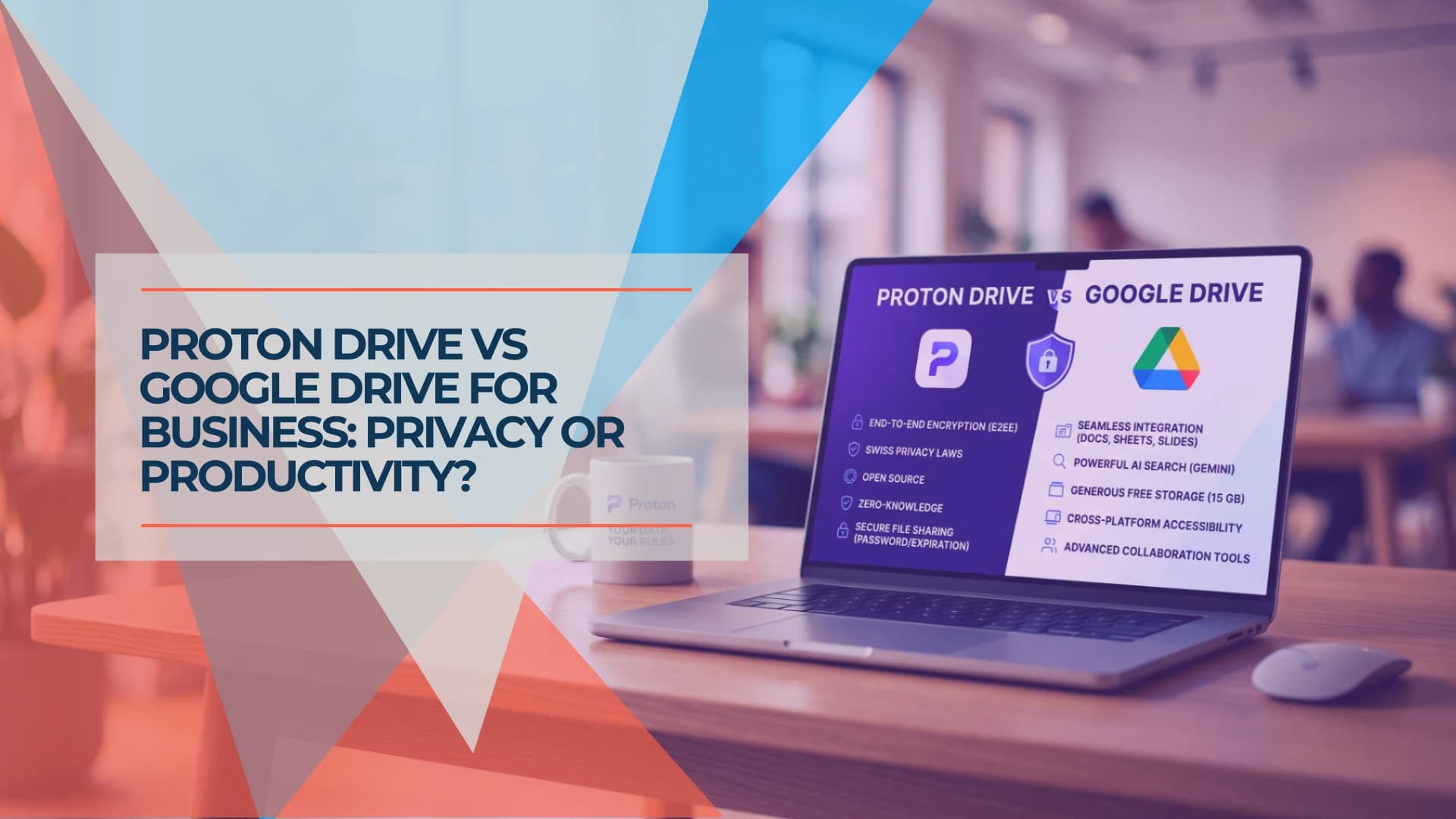
Proton Drive vs Google Drive for Business (2026): Which Fits Your Files?
Compare Proton Drive and Google Drive for business on privacy, collaboration, admin controls, storage, and 2026 pricing. See which fits your team.
11 min read
Moving from Dropbox to Encrypted Cloud Storage: Complete Migration Guide
Step-by-step guide to switching from Dropbox to zero-knowledge encrypted storage like Tresorit, pCloud, or Proton Drive. Includes migration planning, team training, and compliance documentation.
18 min read