The White House Released an AI Framework. Here's What Small Business Owners Should Know
The White House released its national AI legislative framework on March 20, 2026. A plain-language breakdown of what it means—and doesn't mean—for your business.

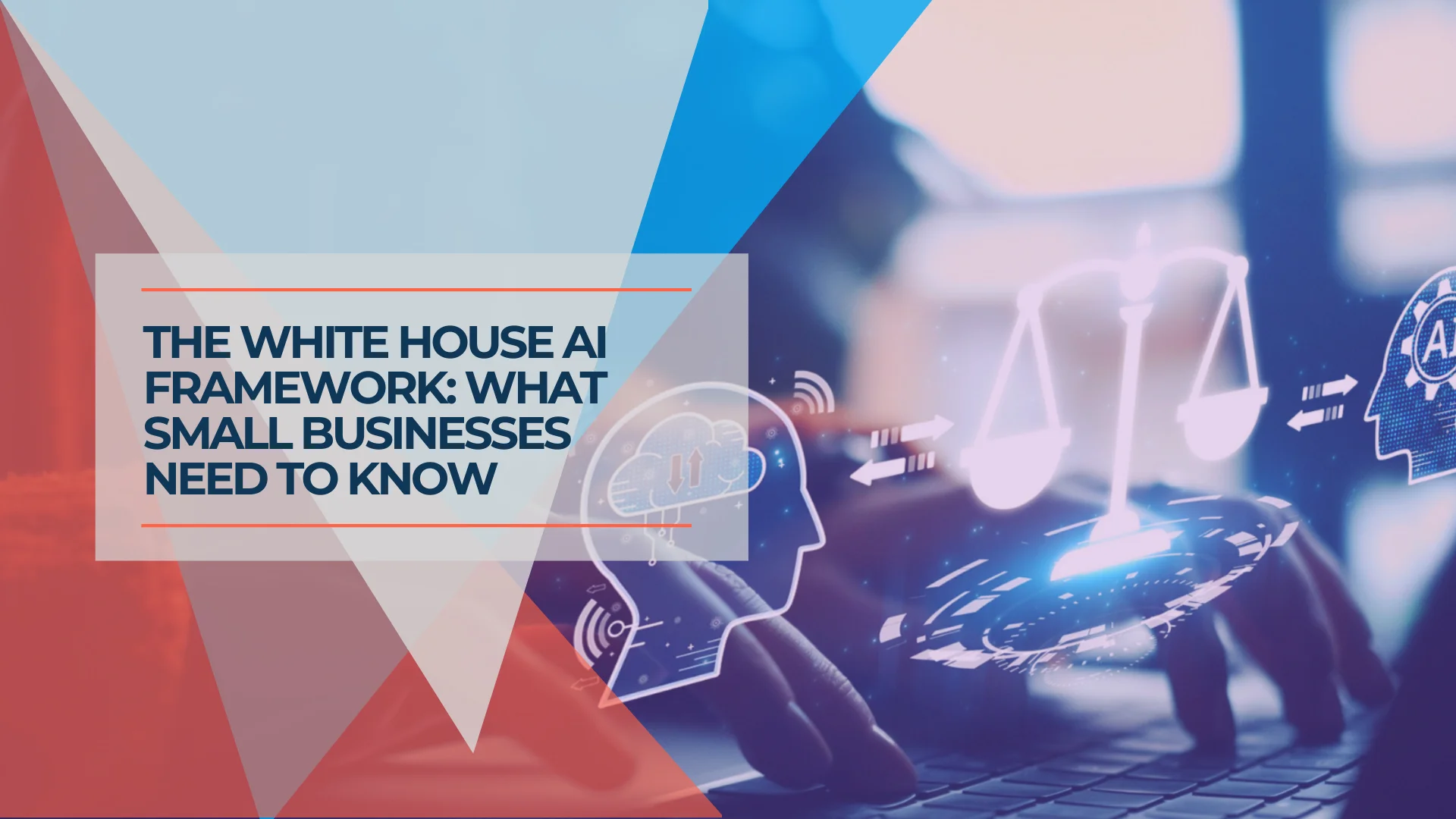
Over two-thirds (68%) of U.S. small businesses now use AI regularly. If you're one of them—using AI to draft emails, summarize contracts, or handle customer questions—the White House's March 2026 national AI legislative framework is set to shape the rules of your tech stack.
Nothing in this release changes your immediate compliance obligations. The framework is a legislative blueprint for Congress, not a signed law—but the regulatory landscape around AI use in business is shifting, and knowing exactly where things stand now prevents compliance headaches down the road.
What Is the 2026 White House AI Legislative Framework?
The 2026 White House AI framework is a legislative blueprint proposing federal guidelines for artificial intelligence without creating new laws.
Released on March 20, 2026 by the Trump Administration, this four-page national legislative framework outlines what the executive branch wants Congress to enact. It creates no new obligations for your business—no deadlines, no fines, no registration requirements. It builds on the December 11, 2025 Executive Order titled Ensuring a National Policy Framework for Artificial Intelligence, which directed agencies including the FTC, FCC, and Commerce Department to study AI policy and report back. The March 2026 release is part of that process completing its first phase.
The administration organized the framework around six objectives:
- Protecting children and empowering parents — platform controls, privacy protections, safeguards against exploitation
- Safeguarding communities and small businesses — economic growth, energy cost controls, combating AI-enabled scams
- Respecting intellectual property rights — balancing creator protections with AI's need to learn from existing content
- Preventing censorship and protecting free speech — guardrails against AI being used to suppress lawful expression
- Enabling innovation and "American AI dominance" — reducing barriers, accelerating deployment, expanding testing environments
- Educating Americans and building an AI-ready workforce — skills training, job creation, workforce development programs
Objective 2 is the one most directly relevant to you. The administration explicitly included small businesses in its pro-growth framing—the framework calls on Congress to provide grants, tax incentives, and technical assistance to help smaller companies adopt AI without disadvantage.
Why Did the White House Release the 2026 AI Framework?
The framework aims to replace conflicting state AI regulations with a single federal preemption standard, simplifying compliance for businesses nationwide.
Over the past two years, dozens of states have passed or are actively considering their own AI laws—and they're not aligned. California's legislation focuses heavily on frontier model safety, consumer transparency, and risk assessments for high-impact AI systems. Colorado's SB 205 targets algorithmic discrimination in "consequential decisions"—a category that includes using AI to screen job applicants, approve credit applications, or make housing decisions. A small business using an AI hiring tool or AI-powered financing application is squarely in scope. Connecticut has added its own consumer notice requirements. Utah's Artificial Intelligence Policy Act (AIPA) specifically targets AI disclosure to consumers—requiring businesses to disclose when a customer is interacting with an AI rather than a human. For a business operating online—even one with a single physical location in Miami—customers in multiple states may technically trigger obligations under different frameworks.
The administration's position is direct: "A patchwork of conflicting state laws would undermine American innovation and our ability to lead in the global AI race." The framework explicitly calls on Congress to establish federal preemption, replacing conflicting state laws with a single national standard.
For small businesses without a legal team, that outcome would be a practical improvement. One set of rules is simpler than fifty.
The Current Reality
Federal preemption requires an act of Congress. Until that passes—and it hasn't—state laws remain fully in effect. If you have customers or employees in California, Colorado, Connecticut, or Utah, you're already operating under active AI legislation, not just proposals.
The framework also addresses AI-enabled scams directly, calling on Congress to augment federal law enforcement's ability to pursue AI-powered fraud. For small business owners who've seen an uptick in sophisticated phishing and spoofing attempts, that's a relevant line—it signals where federal attention is going.
How the 2026 AI Framework Affects Small Businesses
The March 2026 framework creates no immediate legal requirements, but businesses must still comply with active state AI laws and FTC deception guidelines.
Three things worth knowing:
State laws still apply. If you operate in California, Colorado, Connecticut, or Utah—or serve customers there—the AI laws those states have already passed remain in effect. California has been most active, with requirements touching automated decision-making, consumer notice, and risk assessments for certain AI systems. Utah's AIPA requires disclosure when consumers are interacting with AI. If you haven't checked your state exposure, that's worth 20 minutes.
Disclosure now has formal backing. The FTC's March 2026 policy statement made explicit that AI-generated content used to mislead consumers is actionable under Section 5—the existing prohibition on unfair and deceptive acts. There is no federal mandate requiring you to label every AI-assisted email or blog post, but adding a brief "written with AI assistance" note to marketing and customer-facing content costs nothing and keeps you clearly within current FTC guidelines.
AI is being framed as a small business growth tool. Both the framework and H.R. 3679—the Small Business AI Advancement Act that passed the House in February—frame AI adoption as an economic opportunity for small businesses, not primarily a compliance burden. The administration is calling for grants and technical assistance. NIST, if the Advancement Act passes the Senate, would publish plain-language guidance specifically for businesses without dedicated IT or legal teams. That's a useful development.
4 Steps to Prepare Your Business for Federal AI Regulations
Small businesses should inventory AI tools, add disclosures to AI-generated content, verify state compliance, and monitor federal policy updates.
1. Inventory your active AI tools—including shadow AI. Document every AI system in your workflow: ChatGPT for drafts, Grammarly for editing, your CRM's lead scoring, the chatbot on your website. Then check what employees are using on their own. Shadow AI—consumer-grade tools like personal ChatGPT accounts or third-party AI writing apps that staff use without IT approval—is a common and underestimated data risk for SMBs. Employees pasting client contracts, pricing data, or internal communications into unvetted AI systems creates real exposure that exists independent of whatever federal rules eventually land. Know what's in your stack, sanctioned and unsanctioned. Ensure password management and access controls extend to every business account for any AI tool that touches sensitive data.
2. Build a disclosure habit for customer-facing content. Add a brief "written with AI assistance" note to automated marketing and AI-generated outreach. The FTC's March 2026 policy statement made clear that AI-generated content used to mislead consumers is actionable under existing law. If your CRM platform is generating automated outreach, transparency costs nothing and protects you from scrutiny.
3. Check your state. If you have customers, employees, or a physical operation in California, Colorado, Connecticut, or Utah, existing AI legislation already applies to you. California and Utah's requirements touch heavily on consumer transparency (e.g., disclosing when a user is speaking to an AI bot). Colorado's SB 205 focuses on algorithmic discrimination in "consequential decisions"—meaning if you use an AI tool to screen resumes for a job opening or approve customer credit, you are on the hook.
Need a baseline on your current exposure? The Valydex security assessment is a free, privacy-first tool built by the iFeelTech team that runs entirely in your browser. While state AI laws focus on the NIST AI Risk Management Framework, securing your underlying business data via a NIST Cybersecurity assessment like Valydex is the required first step for any AI compliance journey.
4. Assign an internal policy monitor. Set a quarterly calendar reminder to check the FTC's AI guidance page. The pace of regulatory movement is faster than it was 18 months ago, but a quarterly review is enough to stay ahead of surprises.
Upcoming 2026 AI Policy Deadlines to Track
Key developments include the active FTC AI policy statement and the Senate review of the Small Business AI Advancement Act.
-
The FTC AI Policy Statement (Active as of March 11, 2026): The December 2025 executive order gave the FTC 90 days to clarify how Section 5—the prohibition on unfair and deceptive acts or practices—applies to AI models. That statement was issued on March 11. The FTC's existing consumer protection authority already covers AI-generated content that misleads consumers. Deceptive AI output is deceptive conduct under current law. For businesses using AI responsibly, this changes nothing operationally—but formal enforcement guidance is now in place.
-
H.R. 3679 in the Senate (Pending): The Small Business AI Advancement Act passed the House on February 23, 2026 with bipartisan support and is currently in the Senate Commerce Committee. If it passes, NIST produces practical, plain-language AI guidance and evaluation frameworks specifically designed for SMBs without dedicated IT or legal staff.
-
Congressional progress on the framework: The administration aims to work with Congress "in the coming months" to convert the March 2026 blueprint into legislation. Components with bipartisan interest—child safety and workforce development—are likely to move faster. Federal preemption of state AI laws is more contested and will take longer.
The direction of travel is toward clearer, more consistent federal rules. The transition period—where state laws still vary and federal guidance is still forming—is the messy part. Building a few lightweight habits now means you're already in good shape when the rules settle.
The Bottom Line
Nothing in the March 2026 framework requires immediate action from your business. But it signals where federal AI policy is heading, and it's largely favorable to small businesses: fewer conflicting state rules, more resources from NIST, and grants/tax incentives on the legislative wish list. Use the time before rules solidify to build lightweight habits—know your tools, disclose where appropriate, check your state. That's the whole job for now.
Related Resources
- AI Agent Security for SMBs: 2026 Playbook — If you're running AI agents or automation in your tech stack, this covers the governance and security controls you should have in place.
- How AI Cyberattacks Are Targeting Small Businesses — The same AI capabilities driving adoption are also being weaponized against SMBs. Practical defense strategies here.
- Best Password Manager for Small Business — As AI tools access more of your business data, credential security becomes the foundation everything else rests on.
- Best CRM for Small Business — Most modern CRMs now have AI embedded in lead scoring, outreach, and automation—context worth having as disclosure expectations develop.